EMATOLOGIA
CML — Giugno 2024
- ASCIMINIB (ASC) PROVIDES SUPERIOR EFFICACY AND EXCELLENT SAFETY AND TOLERABILITY VS TYROSINE KINASE INHIBITORS (TKI) IN NEWLY DIAGNOSED CHRONIC MYELOID LEUKEMIA (CML) IN THE PIVOTAL ASC4FIRST STUDY
- ASCIMINIB AS INITIAL THERAPY FOR PATIENTS WITH CHRONIC MYELOID LEUKEMIA IN CHRONIC PHASE (ALERTCML)
- TREATMENT PATTERNS AND REAL-WORLD CLINICAL OUTCOMES OF PATIENTS WITH CHRONIC MYELOID LEUKEMIA IN CHRONIC PHASE TREATED WITH ASCIMINIB IN ONCOLOGY PRACTICES IN THE UNITED STATES
- ASCIMINIB (ASC) IS WELL TOLERATED IN PEDIATRIC PATIENTS WITH CHRONIC MYELOID LEUKEMIA IN CHRONIC PHASE (CML-CP): INTERIM PHARMACOKINETICS AND SAFETY RESULTS FROM ASC4KIDS
- CHRONIC MYELOID LEUKEMIA SURVEY ON UNMET NEEDS (CML SUN): UNITED KINGDOM FINDINGS ON BALANCING TOLERABILITY AND EFFICACY GOALS OF PATIENTS AND PHYSICIANS THROUGH SHARED TREATMENT DECISION-MAKING

ASCIMINIB (ASC) PROVIDES SUPERIOR EFFICACY AND EXCELLENT SAFETY AND TOLERABILITY VS TYROSINE KINASE INHIBITORS (TKI) IN NEWLY DIAGNOSED CHRONIC MYELOID LEUKEMIA (CML) IN THE PIVOTAL ASC4FIRST STUDY
CML requires long-term therapy, underscoring the need for treatments (Txs) that improve efficacy without compromising safety and tolerability, enabling patients (pts) to meet Tx goals including treatment-free remission (TFR), currently available to a minority. ASC, the first BCR::ABL1 inhibitor to Specifically Target the ABL Myristoyl Pocket (STAMP), was intentionally designed to be highly specific and minimize off-target effects.
The authors (Andreas Hochhaus et al.) report primary results from ASC4FIRST (NCT04971226), a randomized ph 3 study of ASC vs all current standard-of-care frontline TKIs in pts with newly diagnosed CML. The two primary objectives of the study were to demonstrate superior major molecular response (MMR) rate at wk 48 with ASC vs investigator-selected (IS) TKI and ASC vs IS TKI within the stratum of pts with imatinib (IMA) as their prerandomization-selected (PRS) TKI (ASCIMA vs IS TKIIMA). The study is positive if either objective is met. An unpowered secondary objective was comparing MMR rate at wk 48 of ASC vs IS TKI within the stratum of pts with second-generation (2G) TKIs as their PRS TKI (ASC2G vs IS TKI2G).
Adults with CML diagnosed ≤3 mo before enrollment with no prior Tx except IMA/2G TKIs for ≤2 wk prior to randomization, who provided informed consent were eligible. Pts were randomized 1:1 to receive ASC 80 mg once daily or an IS TKI at standard label doses, stratified by ELTS risk category and PRS TKI (IMA or 2G TKIs). PRS TKI was selected by investigators accounting for pt preference.
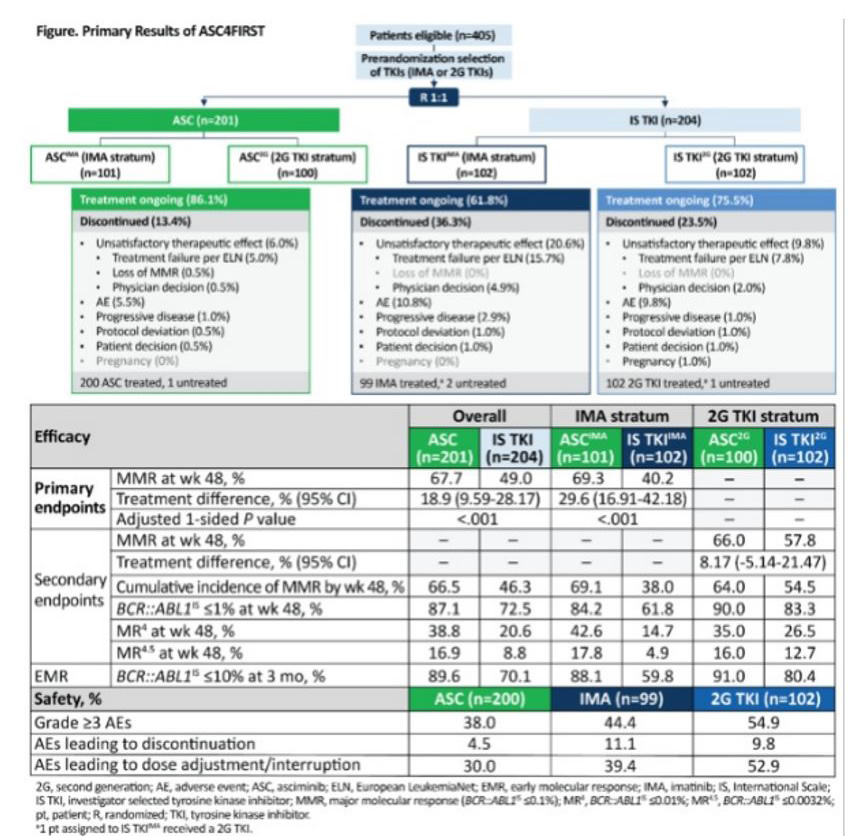
Patients received ASC (n=201: ASCIMA, n=101; ASC2G, n=100) or an IS TKI (n=204: IS TKIIMA, n=102; IS TKI2G, n=102 [nilotinib, 48%; dasatinib, 41%; and bosutinib, 11%]). Median follow-up was 16.3 and 15.7 mo with ASC and IS TKIs, respectively. At cutoff (Nov 28, 2023), Tx was ongoing in 86%, 62%, and 75% of pts receiving ASC, IMA, and 2G TKIs, respectively (Figure).
MMR rate at wk 48 (per ITT) was superior with ASC vs IS TKI (67.7% vs 49.0%) and ASCIMA vs IS TKIIMA (69.3% vs 40.2%), meeting both primary objectives with high statistical significance; rate difference was 18.9% (95% CI, 9.6%-28.2%) and 29.6% (95% CI, 16.9%-42.2%), respectively, both with adjusted 1-sided P<.001. MMR rate at wk 48 was higher with ASC2G vs IS TKI2G (66.0% vs 57.8%).
Higher rates of early and deep molecular responses were achieved with ASC vs IS TKI, ASCIMA vs IS TKIIMA, and ASC2G vs IS TKI2G (Figure).
Consistent with its known safety profile, ASC had markedly favorable safety vs IMA and 2G TKIs. Most frequent all-grade adverse events (AEs) (≥25%) were thrombocytopenia (28%, 28%, 34%), neutropenia (25%, 31%, 34%), diarrhea (16%, 26%, 25%), and anemia (12%, 26%, 23%) with ASC, IMA, and 2G TKIs, respectively, and grade ≥3 AEs (≥6%) were thrombocytopenia (13%, 6%, 14%), neutropenia (10%, 17%, 18%), and increased alanine aminotransferase (2%, 2%, 8%). Rate of arterial occlusive events was 1%, 0%, and 2%, respectively. ASC had better tolerability vs IMA and 2G TKs as shown by lower rates of discontinuation and dose modifications due to AEs (Figure).
In ASC4FIRST, the only head-to-head trial against all current standard-of-care frontline TKIs, ASC demonstrated significantly superior efficacy and excellent safety and tolerability vs IMA and 2G TKIs in pts with newly diagnosed CML. High rates of early and deep responses were achieved with ASC. ASC may accelerate potential for TFR and needs further study. By demonstrating better safety and tolerability and faster, deeper responses vs IMA and 2G TKIs, ASC can be the therapy of choice for CML, optimizing the potential to meet Tx goals without needing to switch.
ASCIMINIB AS INITIAL THERAPY FOR PATIENTS WITH CHRONIC MYELOID LEUKEMIA IN CHRONIC PHASE (ALERTCML)
Although tyrosine kinase inhibitors (TKIs) have dramatically improved the outcome of patients (pts) with CML, there remains need for improvement as by 10 years less than 50% achieve sustained MR4.5 (sine qua non for treatment discontinuation). In addition approximately 40% need change of therapy within 5 years because of lack of efficacy or unacceptable toxicity.
Asciminib is a potent allosteric inhibitor of BCR::ABL1, effective in vitro against BCR::ABL1 mutations that confer resistance to ATP-competitive tyrosine kinase inhibitors (TKIs). In a phase I study of asciminib, 48% of pts with chronic phase CML (CP-CML) resistant to or intolerant of multiple prior TKIs achieved a major molecular response (MMR). This was followed by a phase III trial comparing asciminib vs. bosutinib, in pts who had received > 2 lines of therapy.
At week 96, the MMR rate was higher with asciminib vs. bosutinib (37.6% vs. 15.8%). The combination of asciminib with ATP-competitive TKIs may prevent emergence of resistant clones, potentially increasing the depth of molecular response in patients without deep molecular response (DMR) with single-agent treatment.
The authors (Ehab Atallah et al.) hypothesized that asciminib might lead to more DMR in pts with newly diagnosed CML and that the addition of an ATP-competitive tyrosine kinase inhibitor may lead to a deeper response in pts who have not achieved MR4.5. The trial primary endpoint is the achievement of MR4.5 at 12 months among pts with newly diagnosed CPCML.
This is a multicenter phase 2, non-randomized, open-label, study of asciminib in pts with newly diagnosed CPCML (NCT05143840) conducted in the H Jean Khoury Cure CML Consortium. The study will enroll approximately 50 patients. Patient reported outcomes are collected at multiple timepoints. Pts initially received asciminib 40 mg orally twice daily and the study was later amended, and pts received asciminib 80 mg daily. Peripheral blood BCR::ABL1 by RQ-PCR is monitored at a central lab. Pts who do not achieve MR4.5 after 24 months of single agent asciminib 80 mg daily will be offered the addition of low dose TKI (imatinib 300 mg, dasatinib 50 mg or nilotinib 300 mg once daily) with the goal to attain MR4.5.
As of January 22nd, 2024, 22 pts have enrolled on the study. The median age is 51 (range 25-79) and 36% are female. With a median follow up of 12 weeks, 20 pts remain on study. Of the 12 pts evaluable at 3 months 1 (8.3%), 5 (41.7%) and 6 (8.3%) achieved >MR4.5, MR3 and MR2 as their best response, respectively. Of the 7 patients evaluable at 6 months, 2 (28.6%), 3 (42.9%) and 2 (28.6%) achieved MR4, MR3, and MR2 respectively.
Most AEs were grade 1/2; the only grade 3 non hematological toxicities were elevated CPK (1pt) and increased lipase (2 pts). Two pts discontinued study drug: one for elevated CPK and one for no response (BCR::ABL1 level > 1% at 12 months). The median dose intensity was 80 mg/day. No arterial occlusive events have been observed.
In the frontline setting, asciminib led to rapid early responses in patients with CP-CML. Updated data will be presented at the meeting.
TREATMENT PATTERNS AND REAL-WORLD CLINICAL OUTCOMES OF PATIENTS WITH CHRONIC MYELOID LEUKEMIA IN CHRONIC PHASE TREATED WITH ASCIMINIB IN ONCOLOGY PRACTICES IN THE UNITED STATES
Tyrosine kinase inhibitors (TKIs) are the standard of care for chronic myeloid leukemia in chronic phase (CMLCP). In October 2021, the US FDA approved asciminib, an ABL/BCR::ABL1 TKI, for the treatment of adult patients with Philadelphia chromosome-positive (Ph+) CML-CP previously treated with two or more TKIs or with the T315I mutation.
This study led by Ehab Atallah et al. aimed to describe treatment patterns and real-world clinical outcomes of patients with CML-CP treated with asciminib in US oncology practices.
The Flatiron Health oncology electronic health record (EHR)-derived de-identified database was used. Adult patients were included if they were diagnosed with CML-CP and initiated asciminib between October 29th, 2021, and November 30th, 2022, without prior stem-cell transplant. Treatment patterns from CML-CP diagnosis and overall best molecular response (MR; MR2 [between BCR::ABL ≤1% and >0.1%], MR3 [between BCR::ABL ≤0.1% and >0.01%], MR4 or better [BCR::ABL ≤0.01%]) within 24 weeks from asciminib initiation were described. Time-to-treatment discontinuation and MR3 or better (BCR::ABL ≤0.1%) from asciminib initiation were assessed using Kaplan-Meier analyses. Analyses were conducted overall, and for the subgroups of patients previously treated with two TKIs versus three or more TKIs.
Overall, 111 adult patients with CML-CP initiated asciminib (median age: 62 years, 49.5% female, 64.0% White, 9.9% Black or African American, 65.8% from community-based practices, 85.7% ECOG performance status 0-1, 5.4% with T315I mutation). Non-CML malignancies (19.8%), chronic pulmonary disease , and renal disease (18.9% each) were the most prevalent comorbidities prior to asciminib initiation. Median time was 51 months (IQR: 33-89) from CML diagnosis and 6 months (IQR: 3-9) from asciminib initiation.
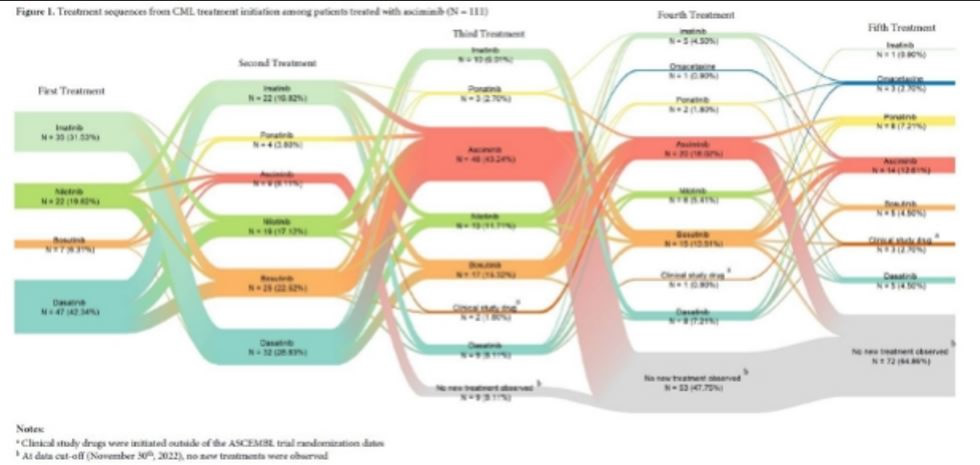
As illustrated in Figure 1, most patients initiated asciminib after two prior TKIs (43.2%), and asciminib was also observed after one prior TKI (8.1%). Most patients initiated asciminib at a dose of 40 mg twice daily (36.9%) or 80 mg once daily (37.8%). Overall best response was MR2, MR3 and MR4 or better in 16.7%, 23.1% and 27.0% of patients within the 24 weeks post-asciminib initiation, respectively. By 24-weeks post-asciminib initiation, 80.9% of patients remained on-treatment and 49.3% achieved or maintained MR3 or better. Among patients previously treated with two TKIs, the overall best response was MR2, MR3 and MR4 or better in 12.9%, 32.3% and 32.3% of patients within 24 weeks post-asciminib initiation, respectively. By 24-weeks post-asciminib, 81.8% remained on-treatment and 71.5% achieved or maintained MR3 or better. Among patients previously treated with three or more TKIs, the overall best response was MR2, MR3 and MR4 or better in 15.8%, 21.1% and 18.5% of patients within 24 weeks post-asciminib initiation, respectively. By 24- weeks post asciminib, 75.3% remained on-treatment and 33.4% achieved or maintained MR3 or better.
In this first real-world study describing patients with CML-CP treated with asciminib, findings from clinical practices in the US during the year following the FDA approval suggest that physicians tend to mainly prescribe asciminib as early as after two prior TKIs and have also used asciminib after one prior TKI. Patients who initiated asciminib after two prior TKIs had higher rates of remaining on treatment and molecular response than those initiated after three or more prior TKIs. Further research is warranted to demonstrate the longer-term efficacy profile of asciminib in a real-world setting.
ASCIMINIB (ASC) IS WELL TOLERATED IN PEDIATRIC PATIENTS WITH CHRONIC MYELOID LEUKEMIA IN CHRONIC PHASE (CML-CP): INTERIM PHARMACOKINETICS AND SAFETY RESULTS FROM ASC4KIDS
Treatment options with improved efficacy, long-term safety and no adverse impact on growth for pediatric patients (pts) with Philadelphia Chromosome-Positive (Ph+) CML-CP are needed. ASC is the first BCR::ABL1 inhibitor that works by Specifically Targeting the Abl Myristoyl Pocket (STAMP), and is approved for adults with Ph+ CML-CP treated with ≥2 prior TKIs.
The phase Ib/II ASC4KIDS study (NCT04925479) evaluates the pharmacokinetics (PK) and safety profile of ASC in pediatric pts. The aim of the study is to report preliminary results from a pre-specified interim analysis to confirm the pediatric dose.
This multi-center, open-label study- conducted by Nobuko Hijiya et al.- included pts aged 1–2 AEs or serious AEs (SAEs). There were no new safety signals compared to the known safety profile of ASC in adults. The average ASC exposure in the PF group was comparable to that observed in adults (median AUClast: 5051 vs 5130 hr*ng/mL; median Cmax: 711 vs 939 ng/mL, respectively [Figure]).
Based on these data, the PF dose of 1.3 mg/kg BID was confirmed as the pediatric dose. All pts on ASC PF experienced AEs (leukopenia, neutropenia, lymphocyte count decreased, platelet count decreased, hemoglobin decreased, abdominal pain, diarrhea, oral mucosa erythema, stomatitis, upper respiratory infection, and hypoalbuminemia, observed in 1 pt each). Grade ≥3 AEs were reported in 2 pts (leukopenia and neutropenia [1 pt] and abdominal pain [1 pt]). Only 1 AE leading to dose interruption and adjustment was reported in the PF group (worsening of neutropenia to Grade 3). No AEs leading to discontinuation, SAEs or predefined dose-limiting toxicities were reported in either group. Preliminary growth data of pts in the AF group will be presented.
ASC exposure with the PF (fed) in pediatric pts was comparable to that of adult pts treated with ASC 40 mg BID (fasted); the confirmed PF dose of 1.3 mg/kg BID will be further tested in Part 2 of the study. Based on AEs reported, ASC AF and PF were safe and well tolerated, with a safety profile consistent with the ASC safety profile in adults.

CHRONIC MYELOID LEUKEMIA SURVEY ON UNMET NEEDS (CML SUN): UNITED KINGDOM FINDINGS ON BALANCING TOLERABILITY AND EFFICACY GOALS OF PATIENTS AND PHYSICIANS THROUGH SHARED TREATMENT DECISION-MAKING
Despite improved survival in patients (pts) with CML, many pts still experience resistance and intolerance with tyrosine kinase inhibitors (TKIs), often requiring a treatment (Tx) switch. Alignment of pt and healthcare provider (HCP) perspectives is needed to ensure appropriate Tx switching, improve quality of life (QoL), and optimise Tx goals. Results of CML SUN, a global survey conducted on pts and HCPs to understand needs and concerns around CML have been recently presented.
Here, the authors (Andrew McGregor et al.) report the findings from the final analysis from pts and HCPs based in the United Kingdom (UK). Aims: To understand the unmet needs and concerns around CML in chronic phase (CML-CP) management in the UK from the perspectives of pts and HCPs.
CML SUN was conducted in pts with CML-CP (aged ≥18 years; receiving a second or later-line TKI) and haematologists (treated ≥10 pts with CML-CP over the last year). In-depth qualitative interviews were conducted with pts and HCPs and results informed the quantitative surveys, which were unique for pts and HCPs.
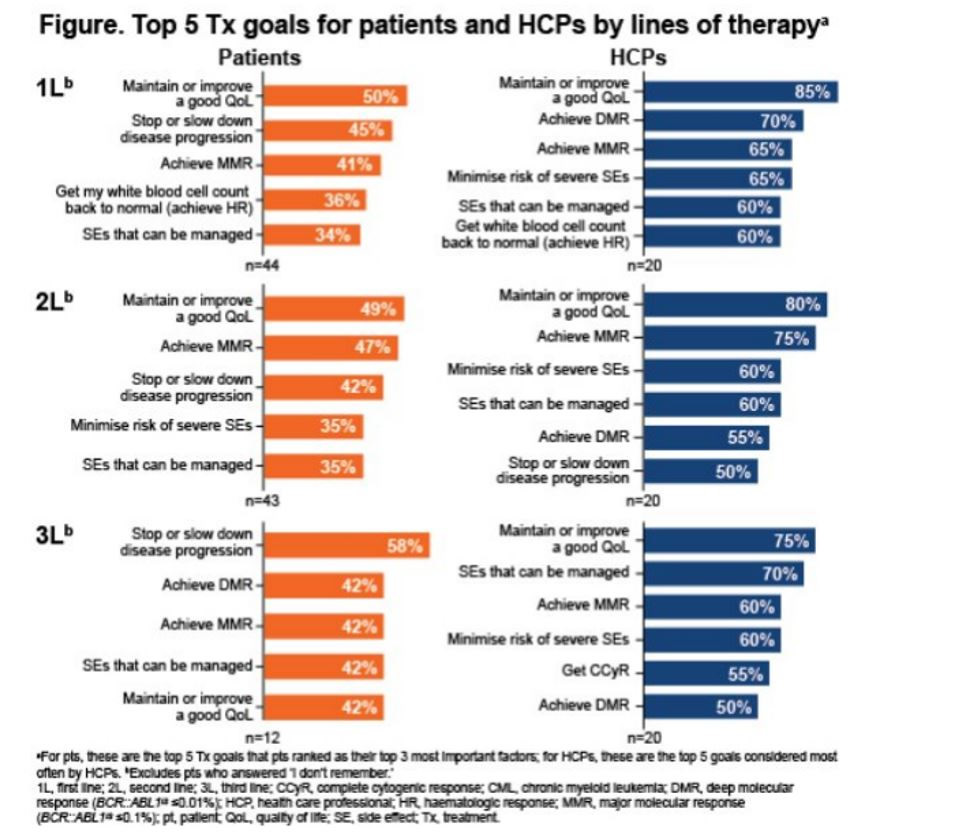
A total of 44 patients with CML-CP and 20 haematologists in the UK participated in the survey. Pts and HCPs shared similar Tx goals for 1L therapy. While the top Tx goal for both pts and HCPs in 1L and 2L was maintaining/improving QoL, pts and HCPs prioritised Tx efficacy and reaching response milestones in 3L Tx. HCPs were more concerned than pts with reducing/managing potential side effects (SEs) across Tx lines (Figure). Around one third of pts (34%) reported discussing multiple Tx options for 1L with their physician. As Tx lines progressed, pts were more likely to only be presented with one Tx option. Regarding Tx decisions, 70% of HCPs presented only one Tx option at 1L to their pts, in agreement with 66% of pts reporting being presented with one Tx option or influenced by one recommendation at 1L.
The proportion of pts reporting only being presented with one Tx option increased across Tx lines, with 71% of pts and 76% of pts at 2L and 3L, respectively. Sixty-five percent of HCPs believe that, although patient input into a Tx decision is welcomed, ultimately, they are the decision makers. Seventy percent of pts understood some, but not all of the information given about their 1L TKI; 65% of HCPs assumed the extent of pt understanding to be of this level. Understanding of all information provided improved for pts across Tx lines.
Overall, 66% of pts were satisfied (34% completely satisfied) with how the current Tx worked to control their disease. Just over half of pts were satisfied with the SE profile (7% completely satisfied). Approximately 70% of patients noticed SEs with their 1L and 2L Tx and informed their HCP, with 22% and 17% of HCPs initiating conversations about SEs in 1L and 2L following abnormal tests. Physical and emotional fatigue and inability to exercise as frequently as before were the highest patient-reported impacts on QoL.
Findings from the UK generally aligned with global results from the CML SUN survey. Tx goals were broadly similar between pts and HCPs. Understanding of information provided to pts improved across Tx lines, however, often pts are not presented with all Tx options. Satisfaction levels with Tx SE profile highlight a need for greater understanding of SE profiles for existing options and more tolerable Tx options. Conversations regarding SEs between pts and HCPs are likely to lead to a better understanding of the impact of tolerability. Communication between pts and HCPs is essential to fully understand Tx decisions, efficacy and tolerability, and improve management of CML.