EMATOLOGIA
MPN — Giugno 2024
- RUXOLITINIB STARTING DOSE REDUCTION AFFECT OVERALL SURVIVAL IN MYELOFIBROSIS: AIFA MONITORING REGISTRIES ANALYSIS
- PATIENT CHARACTERISTICS, TREATMENT PATTERNS, AND HEALTH OUTCOMES IN A REAL-WORLD POPULATION OF PATIENTS WITH MYELOFIBROSIS TREATED WITH FEDRATINIB
- DECIPHERING THE PREDICTORS OF DEATH IN POLYCYTHEMIA VERA: FOCUS ON THE NEUTROPHIL TO LYMPHOCYTE RATIO (NLR) AND THE INCIDENCE OF ARTERIAL THROMBOSIS
- COMPARISON BETWEEN PRETRANPLANT, PERITRANSPLANT AND NO JAK INHIBITION ON OUTCOME AFTER HEMATOPOIETIC CELL TRANSPLANT FOR MYELOFIBROSIS
- AGE-DEPENDENT LINK BETWEEN ARTERIAL THROMBOSIS AND SECONDARY CANCER IN PH-NEG MPN: CASE-CONTROL STUDY INSIGHTS
- REAL-WORLD DATA ON DIRECT ORAL ANTICOAGULANTS IN BCR:ABL1- NEGATIVE MYELOPROLIFERATIVE NEOPLASMS: A MULTICENTER STUDY ON BEHALF OF SUBCOMMITTEE ON MPNS FOR TURKISH SOCIETY OF HEMATOLOGY
- HEALTH-RELATED QUALITY OF LIFE IN ITALIAN PATIENTS WITH PHILADELPHIA-NEGATIVE MYELOPROLIFERATIVE NEOPLASMS COMPARED TO THE GENERAL POPULATION: GIMEMA PROPHECY STUDY
- REVISED “IRR6” MODEL IN INTERMEDIATE-1 RISK MYELOFIBROSIS PATIENTS TREATED WITH RUXOLITINIB
- ANALYSIS OF CARDIOVASCULAR RISK IN 920 PATIENTS WITH MYELOPROLIFERATIVE NEOPLASMS USING NATURAL LANGUAGE PROCESSING
- A REAL-WORLD EVALUATION OF RISK FACTORS FOR DISEASE PROGRESSION IN PATIENTS WITH POLYCYTHEMIA VERA (PV) ENROLLED IN REVEAL
- THE TRIPLE A MODEL-AAA (AGE, ABSOLUTE NEUTROPHIL COUNT, ABSOLUTE LYMPHOCYTE COUNT) PREDICTS SURVIVAL AND THROMBOSIS IN POLYCYTHEMIA VERA
- RUXOLITINIB TREATMENT IN PATIENTS WITH POLYCYTHEMIA VERA REDUCES JAK2 ALLELE BURDEN AND IMPROVES HEMATOCRIT CONTROL AND SYMPTOM BURDEN
- RUXOLITINIB STARTING DOSE REDUCTION AFFECT OVERALL SURVIVAL IN MYELOFIBROSIS: AIFA MONITORING REGISTRIES ANALYSIS

RUXOLITINIB STARTING DOSE REDUCTION AFFECT OVERALL SURVIVAL IN MYELOFIBROSIS: AIFA MONITORING REGISTRIES ANALYSIS
Ruxolitinib is a JAK1/JAK2 inhibitor approved for the treatment of primary myelofibrosis (PMF) or secondary MF (PPV-MF and PET-MF). From sponsored and real-world evidence, the efficacy has been demonstrated on splenomegaly or MF-related symptoms.
The recommended starting dose depends on baseline platelet count, regardless of initial hemoglobin level. In the COMFORT prospective studies, an overall survival (OS) advantage was reported in patients treated with ruxolitinib compared to best available therapy. OS advantage over standard therapy was confirmed in other analyses (Medicare, ERNEST registry)
The aim of this study is to analyze the outcome of MF patients treated with 1st line ruxolitinib according to starting dose.
The authors (Massimo Breccia et al.) analyzed a large Italian series of 3647 MF patients identified by Italian Medicines Agency (AIFA) monitoring registries. AIFA web platform is an administrative database whose main scope is monitoring the appropriateness of drug prescription in Italy; all patients receiving ruxolitinib outside clinical trials are registered in this platform.
This analysis includes MF patients who, as of April 30, 2023, received front-line ruxolitinib for at least 3 years. The focus of the analysis is to compare OS of patients who started ruxolitinib at the full dose, according to the platelet count, and of those who start with a lower-than expected dose for any reason.
To adjust for confounding factors, the Inverse Probability of Treatment Weighting (IPTW) was used. The IPTW is a validated propensity score that calculates a system of weights, based on the probability of patients being assigned to the subpopulation to which they belong. The calculated weights are of the ATE type (Average Treatment Effect on the combined population).
Of the whole cohort of 3647 MF patients, 2448 (67%) started at reduced dose. Comparing with patients who started at full dose, patients who started at reduced dose were older (median age 70 vs 67 years), with large splenomegaly (longitudinal diameter 20 vs 19 cm, volume 64 vs 62), with higher IPSS risk (30.8% vs 26%), worse ECOG score (more than 1 in 14.3% vs 9.6%).
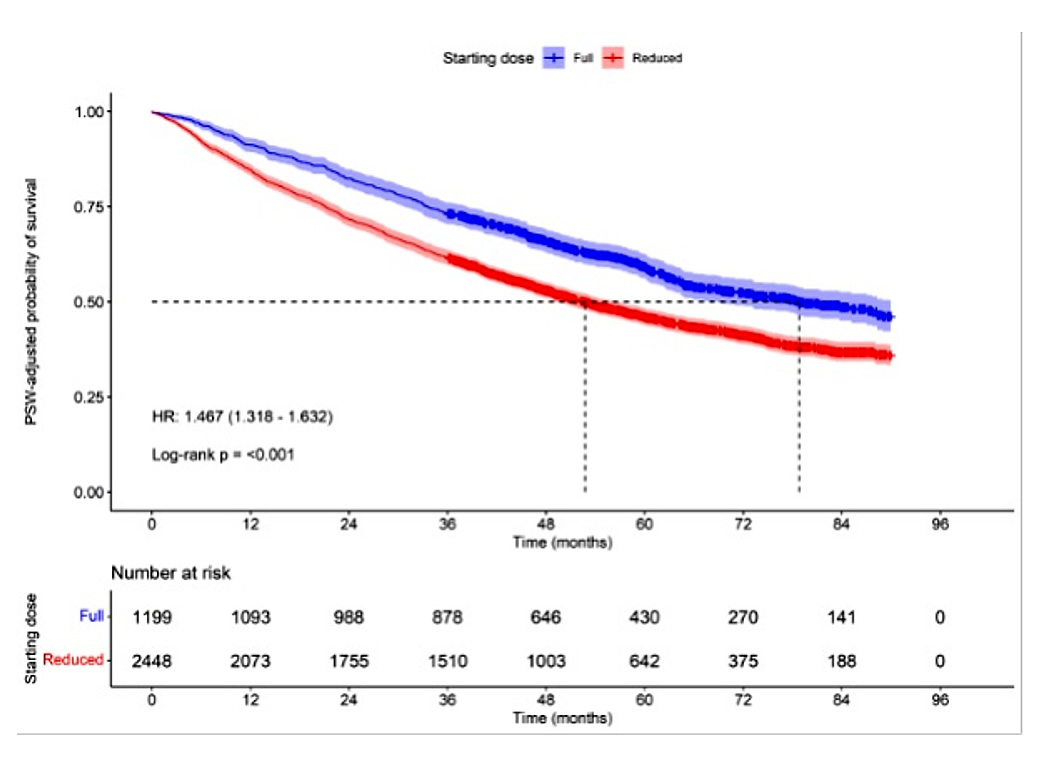
Kaplan Meier analysis showed a median OS of 78.8 months (68.8-na) for patients who started at full dose and 52.8 months for patients who started with reduced dose, with an HR of 1.467 (1.318-1.632) and a log-rank < 0.001 (figure). OS was calculated according to IPSS at baseline: only 285 patients (7.8%) were classified as interm-1 risk and for them, the low mortality recorded in a period of 5 years, the shorter follow-up and the small size of the population examined do not allow us to observe a significant difference. Of 2294 patients (62.9%) identified as interm-2 risk, 789 patients started at full dose and 1505 at reduced dose: Kaplan Meier adjusted analysis revealed a statistical difference [HR 1.501 (1.305-1.727)]. Of 1068 patients identified as high risk, 313 started at full dose and 755 with reduced dose. OS evaluated by Kaplan Meier analysis detected an advantage for patients who started with the correct full dose with an HR of 1.452 (1.224-1724).
In this real-world analysis, most MF patients started with a lower-than-expected dose of ruxolitinib. In intermediate-2/high risk patients, the use of inappropriate starting doses was independently associated with worse outcome. Larger cohorts should be analyzed to test the same effect in intermediate-1 risk patients.

PATIENT CHARACTERISTICS, TREATMENT PATTERNS, AND HEALTH OUTCOMES IN A REAL-WORLD POPULATION OF PATIENTS WITH MYELOFIBROSIS TREATED WITH FEDRATINIB
Myelofibrosis (MF) is characterized by bone marrow fibrosis, splenomegaly, and constitutional symptoms. Fedratinib (FEDR), a selective Janus kinase-2 inhibitor (JAK2i), has shown improved clinical outcomes in clinical trials in patients with MF previously treated with ruxolitinib (RUX). Real-world (RW) evidence on FEDR treatment patterns and outcomes after RUX treatment is limited.
The aim of this study is to describe patients (pts) characteristics, FEDR treatment patterns, and evaluate clinical outcomes among pts with MF who received FEDR after discontinuing RUX treatment in RW settings in Canada (CAN), Germany (GER), and the United Kingdom (UK).
The authors (Francesco Passamonti et al.) present an updated analysis of data collected through medical record review (Mar to Aug 2023) for pts with MF treated with FEDR in clinical practice. Eligible pts had intermediate (int)-2 or high-risk MF at FEDR initiation; had discontinued RUX due to treatment refractoriness, relapse, or intolerance; and had initiated FEDR after date of first availability (ie, CAN: Sep 21, 2020, GER: Feb 9, 2021, UK: Nov 1, 2021) up to 6 mo prior to data abstraction. Spleen size via palpation was required at FEDR initiation (baseline) and at least once within the first 6 mo of FEDR treatment.
Patients who received allogeneic hematopoietic cell transplantation after MF diagnosis or participated in a JAK2i trial before FEDR initiation were excluded. Pt characteristics, FEDR treatment patterns, MF-related symptoms, and spleen size evaluations were reported descriptively. Overall survival (OS) and time to spleen size reduction (ie, spleen response) were estimated using the Kaplan-Meier method.
The final sample included 196 pts with MF (CAN: 45 [22.9%], GER: 86 [43.9%], UK: 65 [33.2%]). Median age at MF diagnosis and FEDR initiation was 65.8 and 68.7 y, respectively. Most pts were male (62.8%), White (82.7%), diagnosed with primary MF (76.5%), had int-2 risk MF (56.1%), and JAK2 v617F mutation (56.1%).
Mean (standard deviation [SD]) Charlson Comorbidity Index score was 2.1 (1.3). Median time from RUX discontinuation to FEDR initiation was 1.2 mo. Common reasons for FEDR initiation were RUX failure (59.2%), FEDR efficacy (57.1%), and splenomegaly (54.6%). Over a median follow-up of 13.8 mo, 108 (55.1%) pts had ongoing FEDR treatment at record abstraction. Median treatment duration among pts with ongoing and discontinued FEDR treatment was 14.3 and 6.3 mo, respectively. Mean (SD) number of MF-related symptoms decreased from 3.5 (2.1) at baseline to 1.3 (1.6) at 6 mo postFEDR initiation. Baseline MF-related symptoms completely resolved in 42.0% (66/157) of pts 6 mo after FEDR initiation.
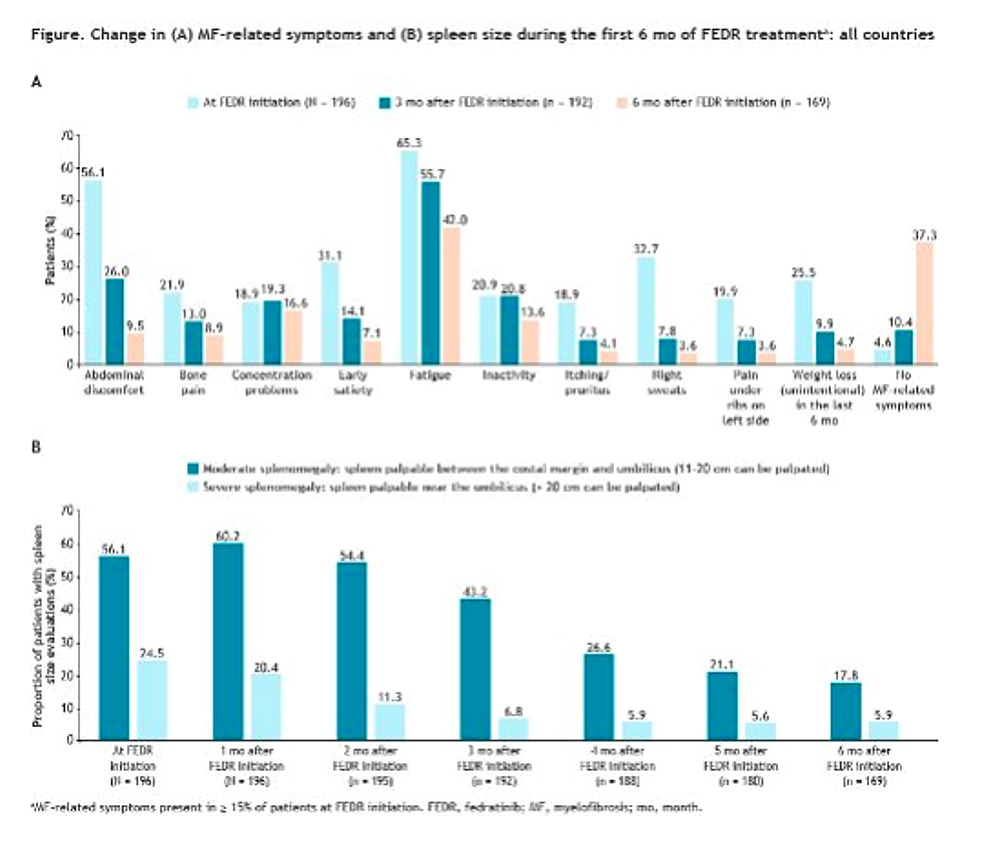
The proportion of pts with no MF-related symptoms increased from 4.6% at baseline to 37.3% at 6 mo after FEDR initiation (Figure). In the first 6 mo of FEDR treatment, moderate splenomegaly (palpable spleen: 11–20 cm) decreased from 56.1% to 17.8%, and severe splenomegaly (palpable spleen: > 20 cm) decreased from 24.5% to 5.9% (Figure). Overall, 66.8% of pts had a reduction in spleen size; median time to spleen response was 4.0 mo (95% confidence interval [CI], 4.0–5.0). Median OS from FEDR initiation was 29.8 mo (95% CI, 23.9–not estimable) with 1-y and 2-y OS rates of 85.9% (standard error [SE], 2.6) and 62.3% (SE, 7.3), respectively.
In this study, 42.0% of pts with MF experienced complete resolution of MF-related symptoms and 66.8% had a spleen size reduction during the first 6 mo of FEDR treatment after RUX discontinuation. Study findings illustrate the RW clinical benefit of FEDR treatment and support results from FEDR clinical trials.
DECIPHERING THE PREDICTORS OF DEATH IN POLYCYTHEMIA VERA: FOCUS ON THE NEUTROPHIL TO LYMPHOCYTE RATIO (NLR) AND THE INCIDENCE OF ARTERIAL THROMBOSIS
The median survival of patients diagnosed with polycythemia vera (PV) is approximately 12-14 years, which is lower than the life expectancy observed in the general population of comparable age and sex. In a previous paper, the authors showed that baseline factors such as age, leukocytosis, history of venous thrombosis and abnormal karyotype independently predicted the risk of mortality in a retrospective international cohort of 1545 PV patients. Moreover, recent evidence highlighted the prognostic significance of baseline neutrophil elevation and lymphocyte depletion in patients with essential thrombocythemia.
The aim of this study is to investigate the potential role of baseline absolute neutrophil count, lymphocyte count and neutrophil-tolymphocyte ratio (NLR) as prognostic indicators of mortality in a prospective cohort of PV patients. The authors also assessed the impact on survival of time dependent events occurring during follow-up, i.e. arterial and venous thrombosis, myelofibrosis, and blast phase (BP) on the risk of mortality.
The authors (Tiziano Barbui et al.) analysed a prospective cohort of 1508 patients enrolled in the ECLAP study to examine (i) the relationship between continuous variables of NLR, absolute lymphocyte and neutrophil counts and survival using generalized additive models (GAMs); (ii) the role of NLR in predicting mortality; (iii) whether and to what extent events occurring during follow-up could influence survival as assessed by time-dependent multivariate analysis.
- GAM models (Figure 1) showed a linear upward trend in the risk of death with increasing absolute neutrophil counts and decreasing lymphocyte counts, with logHRs exceeding 0 (i.e., HR>1) for neutrophil and lymphocyte values greater than 8x10⁹/L and less than 2x10⁹/L, respectively. The NLR showed a similar trend of linear increase in risk as the neutrophil count, but with more precise 95% confidence intervals, especially for extreme values, and reached HR>1 when NLR>5.
- In multivariate analysis of this prospective cohort, we confirmed that age, WBC>15x109/L and venous thrombosis at diagnosis or in previous years, were predictors of death. However, when the NLR was added to the multivariate model, both leukocytosis and previous venous thrombosis lost their statistical significance, and NLR≥5 became independently significant (HR 1.79, p<0.001) together with age, whose HRs progressively increased (1.80 and 3.55 for age 57-66 and ≥67 years, respectively)
- In addition, we included time-dependent variables showing that mortality was also significantly affected by events occurring after a median follow-up of 2.8 years from PV diagnosis. This was expected from the occurrence of myelofibrosis (HR 3.34, p=0.001), but also occurred from arterial thrombosis, which conferred a risk of death similar to that of the development of myelofibrosis (HR 3.29, p<0.001).
This study showed that, in addition to age, the inflammatory biomarker NLR above a threshold of 5 was a strong predictor of death, overshadowing the role of leukocytosis and previous venous thrombosis. Furthermore, incident arterial thrombosis was shown to confer a similar risk of death as myelofibrosis. These findings suggest implications for appropriate monitoring of patients who develop arterial thrombosis after diagnosis of PV.

COMPARISON BETWEEN PRETRANPLANT, PERITRANSPLANT AND NO JAK INHIBITION ON OUTCOME AFTER HEMATOPOIETIC CELL TRANSPLANT FOR MYELOFIBROSIS
The introduction of JAK inhibitors has improved patient outcomes in myelofibrosis. However, allogeneic hematopoietic cell transplantation (HCT) remains the only potentially curative treatment for patients with myelofibrosis, but has considerable treatment-related complications, such as graft-versus-host disease (GvHD). Whether the incorporation of JAK inhibition into the HCT platform leads to improved outcomes is still unclear.
Here the authors (Kristin Rathje et al.) undertook an in-depth analysis of different HCT platforms, comparing immune profiles and outcomes of patients who (1) were never exposed to JAK inhibition vs. (2) patients who received JAK inhibition before transplant but stopped before start of conditioning vs. (3) patients continuing JAK inhibition peri-transplant.
Overall, the authors included 98 myelofibrosis patients undergoing first HCT, of whom 32 had never received JAK inhibition (non-group) and 34 stopped JAK inhibition prior to transplant (pre-group). In another 32 patients, JAK inhibition with ruxolitinib (n=30) or fedratinib (n=2) was continued at the start of conditioning until stable engraftment, tapered at day +21 and stopped at day +28 post-transplant (peri-group). The authors systematically collected immune status on day +14, +21, +30, +100, and +180 post-transplant to compare immune reconstitution between the 3 groups. Immune profiles and dynamics were analyzed and compared in time-dependent and categorical fashion using Wilcoxon tests. Other endpoints were acute GvHD, relapse incidence, and overall survival.
All patients received GvHD prophylaxis with a calcineurin inhibitor and mycophenolate mofetil, and 95% of patients received anti-T-lymphocyte globulin. Most characteristics were well balanced between the groups, while more patients in the peri-group were CALR-positive. The non-group was more enriched in high-risk disease status according to DIPSS compared to the pre- and peri-group (43% vs. 15% vs. 8%).
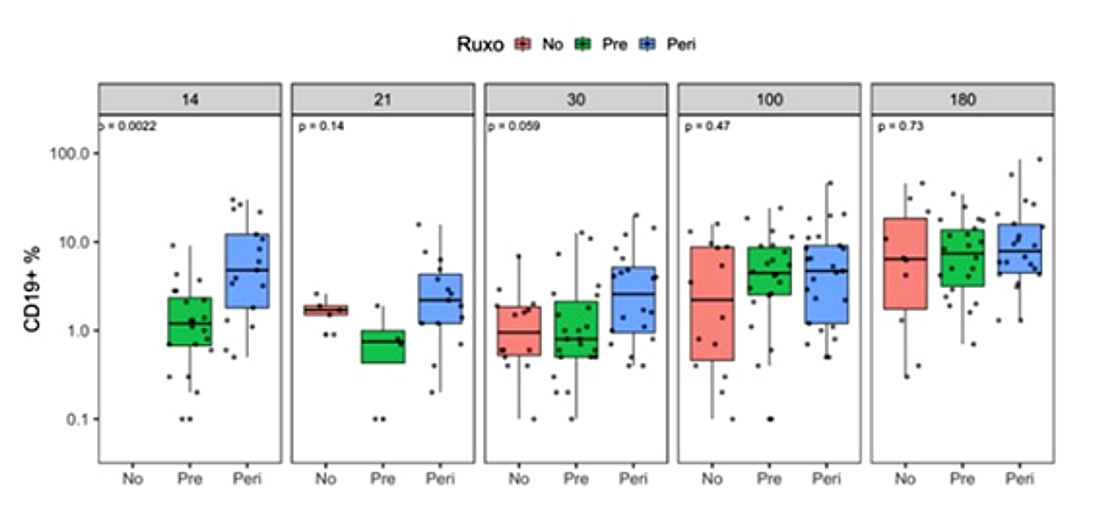
Conditioning was busulfan-based with reduced intensity in all patients. In terms of early immune reconstitution, we found significantly different B-cell recovery, in particular an earlier B-cell recovery at day +14 and day +30 was seen for the peri-group vs. the pre-group (P=0.002 and P=0.05). Of note, no difference was found with regards to T-cell (sub)populations. In terms of late immune reconstitution, patients in the peri-group followed by the pre-group showed significantly increased recovery of gamma-delta T-cells and NK-cells at day +180 compared to patients without JAK inhibition.
Notably, 100% of patients in the peri-group achieved neutrophil engraftment compared with 94% of the pregroup and 90% of patients in the non-group. Acute GvHD was observed in 22% (95% CI, 8-36%) in the perigroup vs. 24% (95% CI, 9-38%) in the pre-group vs. 31% (95% CI, 15-47%) in patients without JAK inhibition. No difference in severity of acute GvHD was identified. After a median follow-up for the pre- and peri-group of 1 year, overall survival at 1 year after transplant was 92% for the peri-group, 72% for the pre-group, and 78% for the non-group. 1-year relapse incidence was 3% for patients receiving peri-transplant ruxolitinib, 12% for the pre-group, and 25% for patients without JAK inhibition.
The use of peri-transplant JAK inhibition resulted in earlier B-cell recovery and higher late recovery of gammadelta T-cells. Peri-transplant JAK inhibition showed lower rates of acute GvHD, excellent survival outcomes and significantly reduced early relapse rates. Complete safety outcomes (hematotoxicity, infections, GvHD) will be presented.
AGE-DEPENDENT LINK BETWEEN ARTERIAL THROMBOSIS AND SECONDARY CANCER IN PH-NEG MPN: CASE-CONTROL STUDY INSIGHTS
The authors (Tiziano Barbui et al.) recently presented findings from a nested case-control study involving cases of Myeloproliferative Neoplasms (MPN) with a subsequent cancer (SC) and MPN patients without cancer (controls), showing the predictive significance of newly occurring arterial thrombosis for cancer development (Blood 2020;135:381-6). The authors assessed whether this finding held true in age-specific groups.
The authors stratified 647 MPN cases (PV: N=216, ET: N=317, MF: N=114) with a second cancer and 1,234 matched MPN cancer-free patients, into the category of under/over 60 years of age; for each cancer case, up to 3 cancer-free controls were matched for center, sex, age at MPN diagnosis, date of MPN diagnosis and duration of MPN disease.
1. Characteristics at MPN diagnosis
Comparison of cases and controls (<60: N=614 vs. >60: N=1267) at MPN diagnosis, revealed differences in the under-60 group: (i) MPN disease duration was twice as long (6.1 vs. 3.3 years), (ii) a trend of higher JAK2 mutation prevalence (74.2% vs. 67.3%, p=0.079), and (iii) a trend of increased ASXL1 gene mutations (27.8% vs. 6.7%, p=0.086).
2. Outcomes after MPN diagnosis and SC
Over a median period of 4.0 years (IQR 1.5-7.8), thrombosis was significantly more common in cases than controls in the under-60 group (16.9% vs. 8.5%, p=0.002), primarily due to arterial rather than venous thrombosis (p=0.001 vs. p=0.087). Conversely, thrombosis frequency was similar in cases and controls over 60 (9.0% vs. 7.9%, p=0.51). Fig. 1A depicts thrombosis-free survival in both groups. The proportion of under-60 patients with total thrombosis remained stable at 25% every 2 years for the 6 years before SC. Conversely, patients over 60 showed a gradual rise in thrombosis events, increasing from 12% more than 6 years before SC to 41% in the year leading up to SC (Fig. 1B). The most common and frequent tumors in MPN cases under 60 vs. over 60 years were female malignancies (breast: 30.5% vs. 15.8%, p<0.001; ovarian/uterine: 11.3% vs. 3.2%, p=0.001), endocrine (6.4% vs. 0.7%, p=0.001) and a trend for melanoma (7.0% vs. 3.9%, p=0.085); conversely, the frequency of colorectal and lung cancer was higher (4.3% vs. 17.5%, p<0.001 and 8.5% vs. 15.4%, p=0.046, respectively) in cases over 60 years of age.
3. Conditional multivariable logistic regression model
In the over 60 group, no predictors of SC emerged, except for a trend towards a 28% increased risk in patients with leukocytosis at the time of MPN diagnosis. In younger individuals, the following factors independently influenced the SC risk: (i) myelofibrosis phenotype compared to ET (HR 2.54; p= 0.056) (ii) arterial thrombosis, i.e. MI, Stroke (HR 2.53; p=0.011) (iii) aspirin therapy which reduced this risk (HR 0.52; p=0.006).
The study reveals age-related differences in the frequency of thrombosis in younger MPN patients prior to SC. In addition to the myelofibrosis phenotype, arterial thrombosis independently predicted cancer in patients under 60.
On the basis of different temporal patterns of thrombosis and cancer in the two age groups we hypothesized that the stability of thrombosis frequency in under 60, would suggest a shared pathogenesis of thrombosis and cancer related to MPN-driven chronic systemic inflammation, whereas in those over 60, the peak of thrombosis occurring in the year before cancer suggests an additive role of lung and colorectal cancer related thrombogenic potential, in addition to MPN systemic inflammation.
Interestingly, aspirin was associated with reduced risk of cancer. Further investigation of the age-dependent dynamics and underlying mechanisms is crucial.

REAL-WORLD DATA ON DIRECT ORAL ANTICOAGULANTS IN BCR:ABL1- NEGATIVE MYELOPROLIFERATIVE NEOPLASMS: A MULTICENTER STUDY ON BEHALF OF SUBCOMMITTEE ON MPNS FOR TURKISH SOCIETY OF HEMATOLOGY
BCR::ABL1-negative myeloproliferative neoplasms (MPNs) pose a substantial risk of thrombosis, leading to significant morbidity and mortality. Anticoagulant therapy, historically based on vitamin K antagonists (VKAs), has limitations in preventing recurrent thrombotic events and managing bleeding complications. Direct oral anticoagulants (DOACs) offer a potential alternative with improved pharmacokinetics and compliance. However, evidence on DOAC efficacy and safety in MPNs remains limited, necessitating further investigation.
In this multicenter retrospective study in Türkiye, the authors (Mehmet Baysal et al.) assessed real-world usage patterns and outcomes of DOACs in MPN patients. Data from patients with polycythemia vera (PV), essential thrombocythemia (ET), or primary myelofibrosis (PMF) receiving DOACs or VKAs for thrombosis or nonvalvular atrial fibrillation (NVAF) were collected from medical records. Thrombotic events and bleeding episodes were documented based on ISTH criteria.
The inclusion criteria consisted of individuals aged 18 years or older with MPN who were being treated with warfarin or any DOAC (including dabigatran, apixaban, rivaroxaban, or edoxaban) for the diagnosis of NVAF or the occurrence of a VTE. An MPN diagnosis of PV, ET, or PMF was considered confirmed if the individuals had supporting mutations like JAK2V617F, CALR, and MPL or, in the case of fully met the World Health Organization criteria.
The primary outcome was the occurrence of either arterial thrombotic events or venous thrombotic events. The secondary outcomes included major and clinically relevant non-major bleeding events. In baseline data, categorical variables were given as numbers and percentages. For comparing the two groups (continuous or ordered categorical variables), the paired or unpaired t-test or Mann-Whitney U test was utilized. For disordered categorical data, the Chi-square test was utilized. Thrombosis-free survival analyses were performed with the estimates of Kaplan Meier survival analysis. All p-values were two-sided, with a 0.05 significance threshold.
Two hundred and twenty patients were included. DOACs were used in 126 patients as first-line anticoagulant therapy or following VKAs. Ninety-four patients were on VKAs, of which 83 as first-line treatment. There were eight thromboses (6.3%) seen in 126 DOAC patients, and similarly, seven episodes (9.4%) of thrombosis were observed in 94 patients using VKA. Major bleeding occurred in seven patients (5.6 %) on DOAC and 3 (3.2%) in VKA. Thrombotic and bleeding risks were comparable between DOACs and VKAs (p=0.708 and p=0.158, respectively) (Table 1). No significant difference was observed in thrombosis-free survival comparing the DOAC and VKA groups (p=0.25). The VKA group had an incidence rate of 1.1 thrombosis/patient/year, while the DOACs group had an incidence rate of 1.9 thrombosis/patient/year.
The management of thrombotic risk in patients with MPNs poses significant clinical challenges, as venous and arterial thromboembolic events are the leading causes of morbidity and mortality in this patient population. To the best of our knowledge, this study included the largest number of MPN patients to date, comparing DOACs with VKA in terms of both efficacy and safety, which suggests DOACs as promising alternatives to VKAs for managing thrombotic risk in MPNs with manageable toxicity.
Despite the limitations of retrospective studies, benefit of DOACs both in terms of efficacy and compliance warrant further investigation through prospective trials. Individualized treatment decisions should consider patient-specific factors, emphasizing collaborative efforts between physicians to optimize MPN management with DOAC therapy.

HEALTH-RELATED QUALITY OF LIFE IN ITALIAN PATIENTS WITH PHILADELPHIA-NEGATIVE MYELOPROLIFERATIVE NEOPLASMS COMPARED TO THE GENERAL POPULATION: GIMEMA PROPHECY STUDY
Dr. Giovanni Caocci, ematology Unit, Businco Hospital, ARNAS Brotzu, Department of Medical Sciences and Public Health, University of Cagliari, Cagliari, Italy
Philadelphia chromosome-negative myeloproliferative neoplasms (MPNs) consist of Polycythemia Vera (PV), Essential Thrombocythemia (ET), and Myelofibrosis (MF). People diagnosed with MPNs experience significant symptoms and a reduced health-related quality of life (HRQoL). However, limited data compares the HRQoL of MPN patients with that of the general population. The authors aimed to compare HRQoL profile of Italian patients with MPNs with that of their peers in the general population. Analyses were performed overall and by MPN disease group.
This was a prospective observational study by GIMEMA. Patients with newly diagnosed MPN (as per the 2016 WHO classification) and an initial diagnosis within one year prior to study inclusion were considered eligible. At study inclusion (baseline), and at the following time points: 3, 6, 12, 18, and 24 months, patients were invited to complete a battery of patient-reported outcomes (PRO) questionnaires, including the EORTC QLQ-C30 questionnaire.
For the purpose of this study, the authors only included baseline data of evaluable patients. HRQoL means scores of the five primary prespecified scales of the study protocol (i.e. fatigue (FA), global QoL/health status (QL), physical (PF), emotional (EF), and role functioning (RF)) of patients with MPNs were compared with that of their peers from the Italian general population (Pilz et al. BMC Public Health 2022;22:1040). Analysis was adjusted by sex, age and health condition. To estimate predicted HRQoL scores to comparing to the observed values of the MPN patients, linear regression models were used. Predefined thresholds (Cocks K, et al., J Clin Oncol 29:89-96, 2011) were used to assess the clinical significance of HRQoL differences between groups (patients vs general population).
A total of 548 evaluable MPN patients enrolled in 26 Italian centers from June 2020 to November 2023 were considered for the purpose of this analysis. The median age was 67 years (IQR 55-74); 52% were male. ET was diagnosed in 216, PV in 202, and MF in 130 patients. ECOG/WHO performance status was worse (≥1) in MF (28%) compared to ET and PV patients (13% and 9%) as well as splenomegaly was more frequently detected in MF (47%) with respect to ET and PV patients (10% and 16%). Hemoglobin was lower in MF (13 g/dL, IQR 11- 15) with more transfusion dependency (11%), platelets were higher in ET (637 x10^9/L, IQR 539-778), and hematocrit was higher in PV (52%, IQR 49-56). Constitutional symptoms were reported by 24% of MPN patients.
Table 1 shows MID detected in the EORTC QLQ-C30 scales of MPN patients compared to their peers in the Italian population. Patients with MF reported clinically meaningful worse outcomes in 4 out of the 5 prespecified primary HRQoL domains, that is, PF (Δ= -10; 95% C.I.=-13.7; -6.4), RF (Δ= -17; 95% C.I.=-21.4; -12.6), QL (Δ=-5.7; 95% C.I.=-9.6; -1.7), and FA (Δ=11.9; 95% C.I.=7.9; 15.9). Clinically meaningful worse scores compared to general population were observed in 2 (fatigue and role functioning) and 1 domain (role functioning), for patients with PV and ET, respectively.
The HRQoL of MPN patients was found to be generally impaired. In particular, MF patients reported the highest prevalence of problems across most of the primary HRQoL domains considered in this real-world study. This information may help to better address most relevant limitations experienced by MPN patients.

REVISED “IRR6” MODEL IN INTERMEDIATE-1 RISK MYELOFIBROSIS PATIENTS TREATED WITH RUXOLITINIB
The Response to Ruxolitinib (RUX) After 6 Months (RR6) allows early identification of RUX-treated myelofibrosis (MF) patients (pts) with lower overall survival (OS).
The aim of this study carried out by Francesca Palandri et al. is to validate the RR6 in a large cohort of MF pts and to develop a prognostic score specific for intermediate-1 (INT1) DIPSS risk pts.
After IRB approval, the “RUX-MF” retrospective study collected 1055 MF pts treated with RUX from 2013. In 776 pts, the RR6 variables were evaluable: RBC transfusions/RUX dose <20mg BID at all timepoints [baseline (BL), 3, 6 months (mo)]; spleen reduction ≥30% from BL at 3, 6 mo. Alternative predictors of OS with p<0.05 in multivariate Cox analysis (MVA) were used to develop the new INT1 RR6 (iRR6) model, assigning a rounded weight to each factor based on its hazard ratio (HR).
Among the 776 evaluable pts, 428 (55.2%) were INT1, 272 (35.0%) INT2 and 76 (9.8%) HIGH risk. Overall, 400 pts died (158 pts INT1).
In the total cohort, 267 (34.4%), 371 (47.8%), and 138 (17.8%) pts were at low (score 0), intermediate (score 1- 2) or high (score >2) risk according to the RR6 model, with a 5-yr OS of 64.1%, 51.8% and 44.5%, respectively (p<0.001) (Fig.A).
In the 428 INT1 pts, rates of spleen reduction ≥30% (SR30) and ≥50% (SR50) from BL were 58.6% and 43.7% (3 mo); 66.8% and 47.9% (6 mo). RBC transfusions at 3 timepoints were required in 2.8% of pts, while at 2 timepoints in 24.1%.
RUX dose was <20mg BID at all timepoints in 52.8% of pts. RUX was underdosed compared to PLT in 61.7% at ≥1 timepoint.
Among the RR6 risk factors, RBC transfusions at all timepoints (HR, 2.1; 95%CI, 1.0-4.4; p=0.05) confirmed significant correlation with OS in MVA. The other variables were not statistically significant: 1] RUX dose <20mg BID at all timepoints (HR, 1.1; p=0.49); 2] SR30 at 3 and/or 6 mo (HR, 1.4; p=0.06); 3] RBC transfusions at 3 and/or 6 mo (HR, 1.4; p=0.07). In INT1 pts, the RR6 model did not discriminate intermediate and low-risk pts, with comparable 5-yr OS of 74.4% and 72.0%, respectively (vs 57.4% in high-risk) (Fig.B).
New variables were tested based on clinical plausibility: 1) SR50 was used instead of SR30; 2) underdosed RUX at ≥1 timepoint replaced RUX dose <20mg BID at all timepoints.
MVA confirmed the following risk factors for shorter OS: 1] underdosed RUX at ≥1 timepoint (HR, 3.9; 95%CI 2.6-5.9; p<0.001); 2] lack/loss of SR50, including no SR50 at mo 3 and 6; no SR50 at mo 6 after SR50 at mo 3 (HR, 1.5; 95%CI 1.1-2.0; p=0.02); 3] RBC transfusions at all timepoints (HR, 1.9; 95% CI, 1.2-2.9; p=0.01). In UVA, RBC transfusion at 2 timepoints was also significant (HR, 2.1; 95%CI 1.1-4.4; p=0.05).
Hemoglobin/platelet count decrease, leukocyte count increase to >25×109/L at 6 mo compared to BL were not significantly associated with OS in UVA.
Two points were assigned to underdosed RUX in ≥1 timepoint; 1.5 points to RBC transfusions at all timepoints and to lack/loss of SR50; 1 point to RBC transfusions at 2 timepoints.
A revised “iRR6” model was built and 3 groups were identified: low (score 0, 20.3%), intermediate (score 1-2, 45.8%) and high risk (score >2, 33.9%), with a 5-yr OS of 84.8%, 76.4% and 56.6%, respectively (p<0.001) (Fig.C).
In a large MF cohort, we validated the RR6 as prognostic model for early detection of RUX-treated pts who might benefit from early therapy switch. With specific adjustments, the ‘iRR6’ model was developed here to achieve a more robust prognostic stratification in INT1 pts. Particularly, deeper spleen responses and underdosing of RUX compared to prescribing indications are key risk factors for poorer outcome in INT1 pts.

ANALYSIS OF CARDIOVASCULAR RISK IN 920 PATIENTS WITH MYELOPROLIFERATIVE NEOPLASMS USING NATURAL LANGUAGE PROCESSING
Thromboembolic events represent the most common cause of morbidity and mortality in myeloproliferative neoplasms (MPN). Natural language processing is a branch of machine learning involving computational interpretation and human language analysis. CogStack is an information extraction architecture incorporating structured and unstructured electronic health record (EHR) components.
The aim of this study conducted by Andrea Duminuco et al., is to employ a machine-learning approach to determine the prevalence and impact of cardiovascular risk factors upon thrombotic events during follow-up.
Data extracted from CogStack was processed by a medical concept annotation toolkit (MedCAT). Using deep learning, MedCAT was used to disambiguate and capture synonyms and acronyms for Systematized Nomenclature of Medicine–Clinical Terms (SNOMED-CT) concepts, whilst also assessing linguistic context. The base MedCAT model was trained in an unsupervised manner on >18 million EHR documents and this was further fine-tuned through 500 clinician annotated MPN specific documents. MedCAT mapped mentions of relevant concepts to respective SNOMED-CT codes and total counts were aggregated and grouped by individual patient.
Data from 360 polycythaemia vera (PV) and 560 essential thrombocythaemia (ET) patients seen at Guys’ and St Thomas NHS Foundation Trust (GSTT) between 2005 and April 2023 were evaluated, including 24,155 individual EHR documents.
In ET, hypertension (HTN) was the most prevalent comorbidity, identified in 21.3% (119) of patients, followed by hypercholesterolemia (9.6%) and smoking (6.6%), while, overall, 20% (112) experienced a thrombotic event. This included thrombosis not otherwise specified (NOS) in 8% (45), cerebrovascular accident (CVA) in 7.7% (43), and myocardial infarction (MI) in 3.6% (20). HTN was also the most identified condition in PV, seen in 23.1% (83) of patients.
In PV, thrombosis NOS was observed in 19.4% (70), CVA in 14.2% (51), venous thromboembolism (VTE) in 23.3% (84) and MI in 3.1% (11). Overall, 35% (126) of cases had a thrombotic event.
Comparing the two cohorts, a significantly greater frequency of events was observed in PV patients for CVA (p=0.002), portal vein thrombosis, and VTE (both p<0.001) when compared to those with ET (Table 1). ET patients with HTN were more likely to have CVA (of 119 HTN-affected, 15 had CVA, and of 441 HTNnegative, 28 had CVA, p=0.032) and VTE than those without (of 119 HTN-affected, 21 had VTE, and of 441 HTN-negative, 44 had VTE, p=0.021). Similarly, PV patients with HTN were also more likely to develop CVA (20:63 vs 31:246, p=0.004). On multivariate analysis, HTN was confirmed as having a central role in increasing the risk of any type of thrombotic event in both ET and PV cohorts (OR 2.5; 95% CI 1.5-4.2; p<0.001 in ET, and 1.5; 95%CI 1.1-2.8; p<0.016 in PV).
The authors describe a novel machine learning approach to assess cardiovascular comorbidities in patients with MPN, allowing big data analysis, with the potential to better define thrombotic risk. The authors provide a rare ‘real-world’ report on the prevalence of comorbidities in this group, confirming increased CVA and VTE in patients with HTN, emphasizing the importance of strict management of this comorbidity. In keeping with previous smaller studies, they also confirm a significantly higher risk of thrombotic events in patients with a diagnosis of PV when compared with ET.

A REAL-WORLD EVALUATION OF RISK FACTORS FOR DISEASE PROGRESSION IN PATIENTS WITH POLYCYTHEMIA VERA (PV) ENROLLED IN REVEAL
PV is a myeloproliferative neoplasm complicated by symptom burden, splenomegaly (SPM), vascular events, and disease progression to myelofibrosis (MF). Current PV risk models include advanced age and history of thrombotic events (TEs), yet information on risk factors for PV progression is limited.
The aim of this study led by Michael Grunwald et al. to assess baseline characteristics and rate of PV progression to MF as risk factors for PV progression in patients (pts) enrolled in The Prospective Observational Study of Patients With Polycythemia Vera in US Clinical Practices Trial (REVEAL).
Eligibility in this analysis required a confirmed PV diagnosis. Progression to MF was defined as meeting any of the following criteria: [1] Death from MF/MDS/AML; [2] new/worsening SPM, plus 2 of the following: white blood cell (WBC) count >11×109/L, platelets (PLT) 1%. Uni- and multivariate logistic regressions were performed to assess risk factors of PV progression.
To confirm PV diagnosis in the 2510 pts enrolled in REVEAL, digital droplet PCR forJAK2 p.V617F was performed on all pts with available biospecimens; 1524/1871 (81.5%) were positive. An additional 365 pts with a physician-reported JAK2 mutation and 134 with a PV diagnosis confirmed by BM aspirate/biopsy were also included; 487 pts who did not meet any of these criteria were excluded. Progression to MF was identified in 135/2023 pts ([3] BM evidence of MF, n=69 [3.4%]; [2] new/worsening SPM, plus 2 of the following: WBC count >11×109/L, PLT 1%, n=37 [1.8%]; [1] death from MF/MDS/AML, n=22 [1.1%]). Median (range) follow-up in pts with and without progression was 3.4 (0-4.9) and 3.7 (0-5.0) y.
In pts with vs without progression, time from PV diagnosis to enrollment was significantly longer, and percentage of pts with history of TEs at enrollment was significantly higher (P11×109/L at enrollment were significant covariates (P0.45 L/L had a significantly longer time from PV diagnosis to enrollment (median [range], 4.4 [0-36.3] vs 2.9 [0-38.5] y), and were significantly more likely to have high PV risk (80.9% vs 77.1%) and receive hydroxyurea at enrollment (40.3% vs 20.5%; P11×109/L, and JAK2 p.V617F VAF at enrollment as significantly associated with an increased PV progression risk.
However, Hct ≤0.45 L/L may be confounded by disease duration and cytoreductive treatment covariates. These results provide additional support for incorporation of disease duration, elevated WBC, and VAF as factors for predicting disease progression and identify history of TE as a potential novel risk factor.
THE TRIPLE A MODEL-AAA (AGE, ABSOLUTE NEUTROPHIL COUNT, ABSOLUTE LYMPHOCYTE COUNT) PREDICTS SURVIVAL AND THROMBOSIS IN POLYCYTHEMIA VERA
In 2023, the triple A prognostic model-AAA (Age, Absolute neutrophil count-ANC and absolute lymphocyte count-ALC) developed by the Mayo Clinic has been shown to excellently predict overall survival (OS) in patients with essential thrombocythemia.
This 4-tiered risk model assigns 4 points for age >70 years, 2 points for age 50-70 years, and 1 point each for ANC>8 x10⁹L and ALC 60 years or thrombosis history).
Statistics were performed with MedCalc Software®. Survival analyses were perfomed with the Kaplan-Meier method, the log rank test, and the Cox regression analysis. Time to thrombosis (TTT) was measured from the time of disease diagnosis until a thrombotic event or last follow-up visit with death being a censoring event. OS was measured from the time of diagnosis until death or the last follow-up visit.
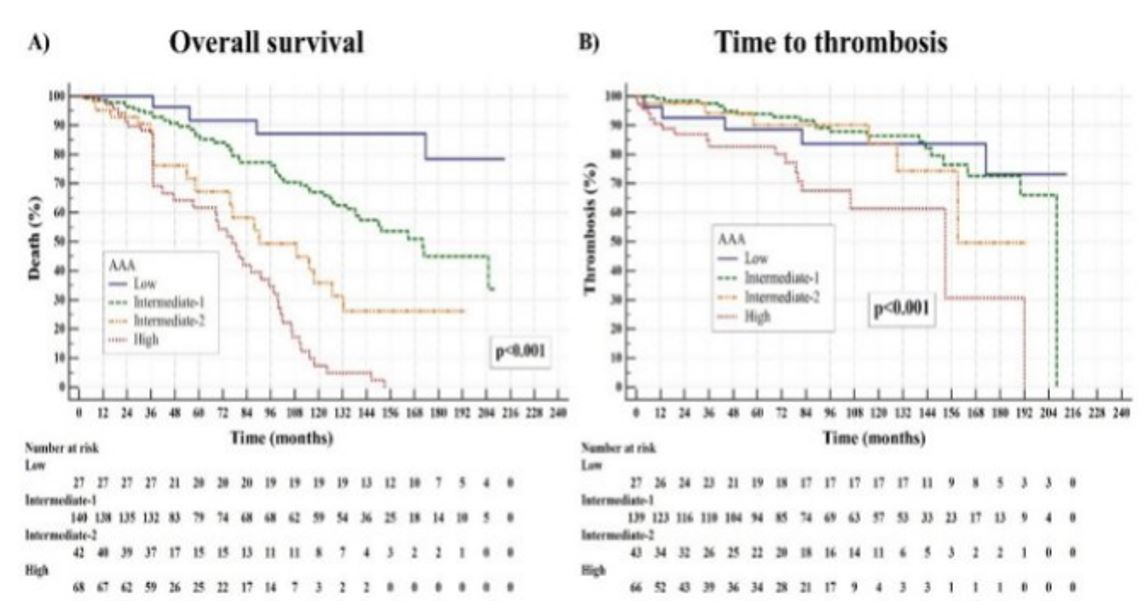
In this styudy carried out by Ivan Krecak et al., a total of 279 PV patients were included; median age was 66 (range 20-92), 131 (47%) were females, the median CCI was 3 (range 0-8), 66 (23.7%) had prior thrombosis high-risk disease was recorded in 201 (72%) of patients and 179 (70.3%) received cytoreductive treatment. A total of 27 (9.7%), 141 (50.5%), 43 (15.4%), and 68 (24.4%) were classified as low, intermediate-1, intermediate-2 and high-risk according to the AAA model, respectively. The median follow-up time was 61.8 months (range 1.8-213); 121 (43.5%) deaths and 48 (17.3%) thrombotic events (arterial=33, venous=15) were recorded. As shown in Figure (A), the AAA model was able to differentiate OS in PV patients with the median OS being not reached, 172, 108, and 76 months for the low, intermediate-1, intermediate-2, and high-risk patients, respectively (p0.050 for all analyses).
The triple A model was also able to differentiate TTT in PV (p<0.001) as shown in Figure (B), with patients in low-to-intermediate risk categories having comparable thrombotic risk over time and patients in the high-risk category having the shortest TTT (high-risk vs. other HR=5.88, p<0.001). The negative prognostic impact of high AAA was evident for both arterial (HR=3.58, p=0.007) and venous thrombotic events (HR=28.79, p<0.001), as well as in patients with (HR=3.54, p=0.042) and without prior thrombosis (HR=6.99, p<0.001).
When simultaneously stratifying patients according to both ELN and AAA high-risk categories, the AAA low-to intermediate risk group had similar thrombotic risk regardless of ELN risk status, whereas only „double-high“ (AAA and ELN) risk patients experienced shorter TTT in comparison to other risk categories (HR=5.88, p<0.001).
This study demonstrates that the AAA risk model may be used for prognostication of PV patients with respect to two most important disease outcomes, death and thrombosis; it also proved useful in patients with and without prior thrombosis, and demonstrated the ability to further refine the prognosis of high-risk ELN patients. Studies on larger number of PV patients are needed to validate our results and to prospectively evaluate whether the triple A model may be used to guide therapeutic decisions.
RUXOLITINIB TREATMENT IN PATIENTS WITH POLYCYTHEMIA VERA REDUCES JAK2 ALLELE BURDEN AND IMPROVES HEMATOCRIT CONTROL AND SYMPTOM BURDEN
In the pivotal RESPONSE and RESPONSE 2 trials, the Janus kinase (JAK)1/JAK2 inhibitor ruxolitinib (RUX) was superior to best available therapy (BAT) at providing hematocrit control, complete hematologic response, and improving disease-related symptoms in patients (pts) with polycythemia vera (PV).
The aim of this study conducted by Claire Harrison et al. is to report results of a post hoc pooled efficacy analysis using data from the RESPONSE studies.
RESPONSE and RESPONSE 2 were randomized, open-label, multicenter, phase 3 trials that assessed efficacy and safety of RUX in adults with PV who had resistance/intolerance to hydroxyurea. Splenomegaly was required for RESPONSE but not RESPONSE 2; pts in both studies were randomized 1:1 to RUX (starting dose, 10 mg twice daily) or BAT (most commonly hydroxyurea [59%, 49%] or interferon formulations [12%, 13%] in RESPONSE and RESPONSE 2, respectively).
Pts randomized to BAT in either trial could cross over to RUX at the time of primary analysis (Wk 32 in RESPONSE; Wk 28 in RESPONSE 2) or later for efficacy or safety reasons. In this pooled analysis, hematocrit control (hematocrit <45% maintained since Wk 16 with ≤1 phlebotomy occurring post randomization and before Wk 4) was assessed at Wk 28 and 80.
Symptom control using the Myeloproliferative Neoplasm Symptom Assessment Form Total Symptom Score (MPN-SAF TSS) and changes in JAK2V617F allele burden were also assessed. Response rate 95% CIs were calculated using the Clopper Pearson exact method; odds ratio (OR) and 95% CI for comparisons of proportions of pts achieving ≥50% reduction from baseline in MPN-SAF TSS were calculated by the Mantel-Haenszel method.
Overall, 371 pts were randomized in RESPONSE and RESPONSE 2 (RUX, n=184; BAT, n=187). Pt baseline characteristics were similar across trials and treatment groups. Median (range) age in the overall pooled analysis population was 62.0 (26–90) years; most pts were male (62.5%) and White (88.1%). At Week 28, 62.0% (95% CI, 54.5%–69.0%) of RUX pts achieved hematocrit control vs 18.2% (12.9%–24.5%) of BAT pts. Durable hematocrit control was maintained to Wk 80 by 47.3% (95% CI, 39.9%–54.8%) of pts randomized to RUX (nearly all BAT pts crossed over to RUX). More pts receiving RUX vs BAT achieved ≥50% reduction from baseline in MPN-SAF TSS at Wk 16 (the only common timepoint in both studies; 48.7% [95% CI, 40.7%–56.8%] vs 18.0% [95% CI, 12.5%–24.6%]; OR, 4.3 [95% CI, 2.6–7.2]).
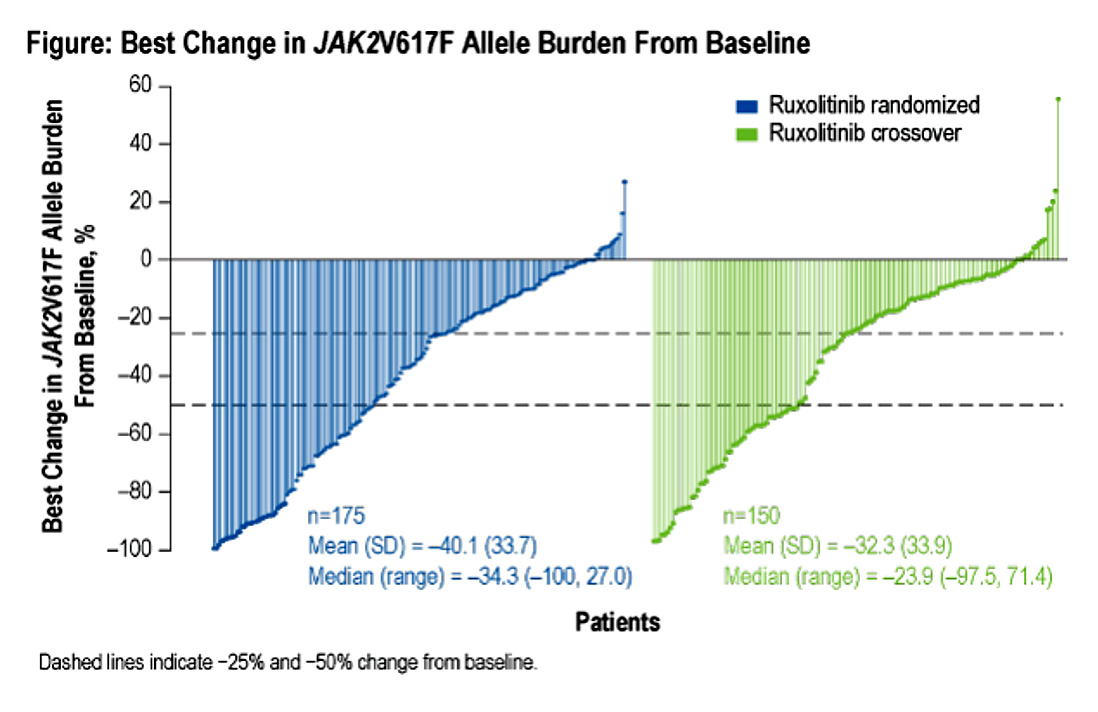
Mean (SD) change from baseline to Wk 16 in MPNSAF TSS was −4.4 (10.0) for RUX pts and 0.6 (6.9) for BAT pts. JAK2V617F allele burden decreased consistently from baseline to Week 208 in RUX patients. Mean JAK2V617F allele burden in pts randomized to RUX decreased from 66.1% to 41.4% at 4 years. A ≥25% decrease in JAK2V617F allele burden was observed in 57.1% of pts randomized to RUX and ≥50% decrease in 38.9%; similar reductions were observed following crossover from BAT to RUX (Figure), with decreases of ≥25% and ≥50% in 48.7% and 35.3% of pts, respectively. Analysis of the BAT group (limited by small pt numbers after Wk 32) showed a best decrease of ≥25% and ≥50% in 7.2% and 2.6% of pts, respectively.
In this pooled analysis of RESPONSE and RESPONSE 2, pts with PV treated with RUX achieved durable hematocrit control through Wk 80 and had better symptom control at Wk 16 than those who received BAT.
Reductions in JAK2V617F allele burden were consistently observed through Wk 208 in pts treated with RUX, including those who crossed over from BAT. Taken together, these results provide further evidence of the pt benefit of RUX in pts with PV with or without splenomegaly
RUXOLITINIB STARTING DOSE REDUCTION AFFECT OVERALL SURVIVAL IN MYELOFIBROSIS: AIFA MONITORING REGISTRIES ANALYSIS
Ruxolitinib is a JAK1/JAK2 inhibitor approved for the treatment of primary myelofibrosis (PMF) or secondary MF (PPV-MF and PET-MF). From sponsored and real-world evidence, the efficacy has been demonstrated on splenomegaly or MF-related symptoms. The recommended starting dose depends on baseline platelet count, regardless of initial hemoglobin level.
In the COMFORT prospective studies, an overall survival (OS) advantage was reported in patients treated with ruxolitinib compared to best available therapy. OS advantage over standard therapy was confirmed in other analyses (Medicare, ERNEST registry).
The aim of the study carried out by Massimo Breccia et al., is to analyze the outcome of MF patients treated with 1st line ruxolitinib according to starting dose. The authors analyzed a large Italian series of 3647 MF patients identified by Italian Medicines Agency (AIFA) monitoring registries. AIFA web platform is an administrative database whose main scope is monitoring the appropriateness of drug prescription in Italy; all patients receiving ruxolitinib outside clinical trials are registered in this platform. This analysis includes MF patients who, as of April 30, 2023, received front-line ruxolitinib for at least 3 years. The focus of the analysis is to compare OS of patients who started ruxolitinib at the full dose, according to the platelet count, and of those who start with a lower-than expected dose for any reason. To adjust for confounding factors, the Inverse Probability of Treatment Weighting (IPTW) was used. The IPTW is a validated propensity score that calculates a system of weights, based on the probability of patients being assigned to the subpopulation to which they belong. The calculated weights are of the ATE type (Average Treatment Effect on the combined population).
Of the whole cohort of 3647 MF patients, 2448 (67%) started at reduced dose. Comparing with patients who started at full dose, patients who started at reduced dose were older (median age 70 vs 67 years), with large splenomegaly (longitudinal diameter 20 vs 19 cm, volume 64 vs 62), with higher IPSS risk (30.8% vs 26%), worse ECOG score (more than 1 in 14.3% vs 9.6%). Kaplan Meier analysis showed a median OS of 78.8 months (68.8-na) for patients who started at full dose and 52.8 months for patients who started with reduced dose, with an HR of 1.467 (1.318-1.632) and a log-rank < 0.001 (figure). OS was calculated according to IPSS at baseline: only 285 patients (7.8%) were classified as interm-1 risk and for them, the low mortality recorded in a period of 5 years, the shorter follow-up and the small size of the population examined do not allow us to observe a significant difference. Of 2294 patients (62.9%) identified as interm-2 risk, 789 patients started at full dose and 1505 at reduced dose: Kaplan Meier adjusted analysis revealed a statistical difference [HR 1.501 (1.305-1.727)]. Of 1068 patients identified as high risk, 313 started at full dose and 755 with reduced dose. OS evaluated by Kaplan Meier analysis detected an advantage for patients who started with the correct full dose with an HR of 1.452 (1.224-1724).
In this real-world analysis, most MF patients started with a lower-than-expected dose of ruxolitinib. In intermediate-2/high risk patients, the use of inappropriate starting doses was independently associated with worse outcome. Larger cohorts should be analyzed to test the same effect in intermediate-1 risk patients.