
EMATOLOGIA
CML — Giugno 2025
- ASCIMINIB (ASC) SHOWS SUPERIOR TOLERABILITY VS NILOTINIB (NIL) IN NEWLY DIAGNOSED CHRONIC MYELOID LEUKEMIA IN CHRONIC PHASE (CML-CP): PRIMARY ENDPOINT RESULTS OF THE PHASE (PH) 3B ASC4START TRIAL
- IMPROVED PATIENT-REPORTED OUTCOMES (PROS) WITH ASCIMINIB (ASC) VS INVESTIGATOR-SELECTED TYROSINE KINASE INHIBITORS (IS-TKIS) IN NEWLY DIAGNOSED CHRONIC MYELOID LEUKEMIA (CML): ASC4FIRST WK 48 ANALYSIS
- INTERIM ANALYSIS (IA) RESULTS FROM ASC2ESCALATE SUPPORT ASCIMINIB (ASC) AS A TREATMENT (TX) OPTION IN CHRONIC-PHASE CHRONIC MYELOID LEUKEMIA (CML-CP) AFTER 1 TYROSINE KINASE INHIBITOR (TKI)
- ASC4OPT STUDY: HIGH EFFICACY AND FAVORABLE TOLERABILITY OF ASCIMINIB ONCE OR TWICE DAILY IN CML PATIENTS WITH SUBOPTIMAL RESPONSE, RESISTANCE OR INTOLERANCE OF 2 OR MORE TYROSINE KINASE INHIBITORS

ASCIMINIB (ASC) PROVIDES SUPERIOR EFFICACY AND EXCELLENT SAFETY AND TOLERABILITY VS TYROSINE KINASE INHIBITORS (TKI) IN NEWLY DIAGNOSED CHRONIC MYELOID LEUKEMIA (CML) IN THE PIVOTAL ASC4FIRST STUDY
Tyrosine kinase inhibitors (TKIs) have improved treatment (tx) outcomes in patients (pts) with newly diagnosed CML-CP. Since CML requires prolonged tx, an agent is needed that is both highly efficacious and well tolerated, enabling pts to achieve long-term tx goals such as tx-free remission. ASC, the first BCR::ABL1 inhibitor to Specifically Target the ABL Myristoyl Pocket, received approval in the US for newly diagnosed CML-CP based on major molecular response (MMR) rate in the ph 3 ASC4FIRST trial (NCT04971226). Compared with the broad selectivity of second-generation (2G) TKIs, ASC may reduce off-target effects and improve tolerability while maintaining efficacy, allowing pts to remain on frontline tx. We present results from ASC4START (NCT05456191), a randomized ph 3b trial with the primary objective of assessing tolerability of ASC vs 2G TKI NIL in pts with newly diagnosed CML-CP.
The primary endpoint was time to tx discontinuation due to adverse event (TTDAE), which included AEs leading to tx discontinuation and deaths due to AE. Secondary endpoints included molecular response and safety. Adults with newly diagnosed CML-CP were randomized 1:1 to receive ASC 80 mg once daily or NIL 300 mg twice daily, stratified by ELTS risk category. A total of 568 pts were recruited from 120 sites across 24 countries to receive ASC (n=284) or NIL (n=284). Two pts who did not receive NIL were excluded from safety analyses.
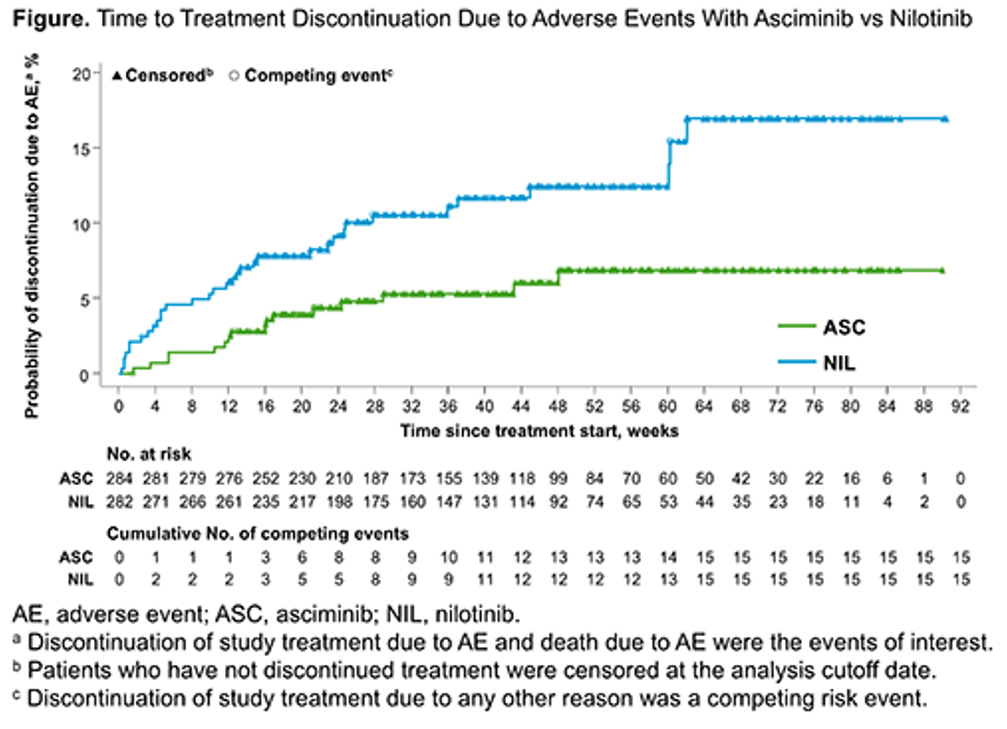
The study met its primary endpoint, showing statistically significant difference in TTDAE in favor of ASC with a cause-specific hazard ratio of 0.45 (95% CI, 0.25-0.81; P=.004). By cutoff (Sep 3, 2024), 10.9% and 17.3% of pts discontinued ASC vs NIL, respectively, most commonly due to AEs (4.9% vs 11.6%) and unsatisfactory therapeutic effect (2.5% vs 2.8%). Median follow-up was 9.7 mo. Fewer pts discontinued due to AEs or death with ASC (16/284 [5.6%]) vs NIL (34/282 [12.1%]). Probability of discontinuation due to AEs was lower with ASC vs NIL (Figure). There were 3 deaths on study due to AEs (ASC: cardiac arrest and suicide, n=1 each; NIL: cardiac arrest, n=1).
Median exposure duration was 39.1 wk with ASC vs 38.0 wk with NIL; mean relative dose intensity was 94.8% vs 92.6%, respectively. All-grade AEs occurred in 80.3% of pts with ASC vs 86.5% with NIL; grade ≥3 AEs occurred in 25.0% and 31.9% of pts, respectively. AEs leading to dose adjustment/interruption occurred in 24.3% of pts with ASC vs 30.1% with NIL. Most common all-grade AEs (≥10%) with ASC vs NIL were thrombocytopenia (15.1% vs 13.8%), headache (10.2% vs 13.1%), myalgia (10.2% vs 8.2%), rash (8.5% vs 16.3%), and increased alanine aminotransferase (3.2% vs 12.4%). AEs of special interest included arterial occlusive events (0.7% vs 2.1%), acute pancreatitis (clinical events; 0.4% vs 2.5%), and hepatotoxicity (including laboratory terms; 8.1% vs 24.8%).
Molecular response rates by wk 12 were higher with ASC vs NIL, including BCR::ABL1IS ≤10% (89.8% vs 82.0%), BCR::ABL1IS ≤1% (69.0% vs 52.5%), MMR (22.9% vs 10.2%), MR4 (4.6% vs 1.1%), and MR4.5 (2.5% vs 0.4%). ASC4START met the primary endpoint in this interim analysis with ASC showing superior tolerability vs NIL based on TTDAE. The study is ongoing, with analyses planned for longer-term tolerability, quality of life, and efficacy. Combined with ASC4FIRST data, results suggest ASC may be a preferred therapy for newly diagnosed CML-CP, enabling more pts to reach tx goals without requiring a tx switch.
IMPROVED PATIENT-REPORTED OUTCOMES (PROS) WITH ASCIMINIB (ASC) VS INVESTIGATOR-SELECTED TYROSINE KINASE INHIBITORS (IS-TKIS) IN NEWLY DIAGNOSED CHRONIC MYELOID LEUKEMIA (CML): ASC4FIRST WK 48 ANALYSIS
Many patients (pts) with newly diagnosed chronic phase (CP) CML have persistent low-grade adverse events (AEs) that can reduce health-related quality of life (HRQOL) and treatment (tx) adherence and prevent pts from achieving tx goals.
CML txs that optimize efficacy, safety, and tolerability are needed. ASC, the first BCR::ABL1 inhibitor to Specifically Target the ABL Myristoyl Pocket, received FDA approval for newly diagnosed CML-CP based on superior efficacy vs IS-TKIs in the wk 48 analysis of the pivotal ph 3 ASC4FIRST trial (NCT04971226) and is approved worldwide for CML-CP after ≥2 prior TKIs. The authors present PROs from ASC4FIRST (wk 48 analysis cutoff: Nov 28, 2023). The secondary study endpoint for PROs was change from baseline (BL) in EORTC QLQ-C30 and EORTC QLQ-CML24 overall scores and individual scales. Exploratory endpoints for PROs were PRO-CTCAE item scores and the FACT-GP5 item. PRO-CTCAE items were fatigue, vomiting, nausea, loose/watery stools, headache, arm/leg swelling, rash, itchy skin, and aching muscles.
Adults with newly diagnosed CML-CP were randomized 1:1 to receive ASC or an IS-TKI and stratified by ELTS risk category and prerandomization selected TKI (imatinib/second-generation TKI). Pts completed PRO questionnaires on electronic devices (ePRO), and scores were calculated per EORTC scoring manuals. Improvements in QLQ-C30 and QLQ-CML24 items were defined as an increase in score for functional scales and global health status/QOL, and a decrease for symptom scales. A total of 405 pts were randomized to ASC (n=201) or IS-TKIs (n=204). Median follow-up was 16.3 mo with ASC and 15.7 mo with IS-TKIs. At cutoff, 194 pts with ASC and 195 pts with IS-TKIs had ≥1 PRO assessment. Completion rates in pts on therapy (with PRO assessments at BL and ≥1 post BL) receiving ASC vs IS-TKIs, respectively, were balanced for QLQ-C30 (BL: 57.7% vs 59.0%; wk 48: 80.5% vs 72.3%) and QLQ-CML24 (BL: 56.2% vs 56.4%; wk 48: 79.9% vs 71.0%). Per QLQ-C30, more pts receiving ASC vs IS-TKIs had improvements in fatigue (44.3% vs 38.6%), pain (32.9% vs 20.0%), HRQOL (43.0% vs 27.1%), and cognitive (20.3% vs 12.9%) and social functioning (26.6% vs 17.1%) (Figure). Fewer pts receiving ASC vs IS-TKIs had improvements in financial difficulties (15.2% vs 20.0%) and constipation (10.1% vs 20.0%). Per QLQ-CML24, more pts receiving ASC vs IS-TKIs had improvements in symptom burden (39.0% vs 16.7%), impact on daily life (61.0% vs 40.9%), worry/mood (49.4% vs 33.3%), and body image (23.4% vs 15.2%), and satisfaction with care and information (44.2% vs 27.3%) (Figure).
Based on PRO-CTCAE, pts receiving ASC vs IS-TKIs had fewer and less severe pain- and gastrointestinal-related AEs, less fatigue, and slightly less severe itchy skin. Per FACT-GP5, 68.4% of pts with ASC and 45.5% with IS-TKIs were not bothered by tx side effects, suggesting better tolerability. Exploratory analyses to evaluate the impact of missing BL PRO data and adjustment of the global health status/QOL domain scoring due to incorrect ePRO programming indicated no substantial impact on conclusions using the PRO data.
In ASC4FIRST, ASC was associated with improvements in HRQOL, cognitive and social functioning, symptom burden, and impact on daily life and satisfaction with care and information compared with IS-TKIs at wk 48. PROs, along with the superior efficacy and remarkable safety profile of ASC in ASC4FIRST, continue to support ASC as a tx of choice for newly diagnosed CML-CP.

INTERIM ANALYSIS (IA) RESULTS FROM ASC2ESCALATE SUPPORT ASCIMINIB (ASC) AS A TREATMENT (TX) OPTION IN CHRONIC-PHASE CHRONIC MYELOID LEUKEMIA (CML-CP) AFTER 1 TYROSINE KINASE INHIBITOR (TKI)
Within 1 year of tx, ≤30% of patients with CML-CP on a second TKI (2L) require tx switch, leading to worse outcomes and limited subsequent tx options. Initially approved for CML-CP after ≥2 TKIs (3L+), ASC was recently approved in the US for newly diagnosed (1L) and previously treated (2L+) CML-CP. ASC2ESCALATE (NCT05384587) is a trial of 1L and 2L ASC in CML-CP with dose escalation for pts with suboptimal response. A previous IA of the 2L cohort reported ASC's safety (n=71) and wk 24 efficacy (n=28; BCR::ABL1IS ≤1%, 85.7%; major molecular response [MMR], 42.9%). We report updated safety (n=101) and wk 24 efficacy (n=63) results.
ASC2ESCALATE is a phase 2, single-arm, open-label US study of 1L and 2L ASC in adults with CML-CP without the T315I mutation. 2L cohort-eligible pts had discontinued prior tx due to warning or failure per ELN 2020 or intolerance with BCR::ABL1IS >0.1% at screening. Pts received ASC 80 mg once daily (QD). At wk 24, dose was increased to 200 mg QD if BCR::ABL1IS >1%. At wk 48, if BCR::ABL1IS >0.1%, dose was increased from 80 to 200 mg QD or from 200 mg QD to 200 mg twice daily, or pts could be taken off study. At wk 24 and/or 48, pts were ineligible for dose escalation and continued the same dose if they had any grade 3/4 or persistent grade 2 toxicity refractory to optimal management.
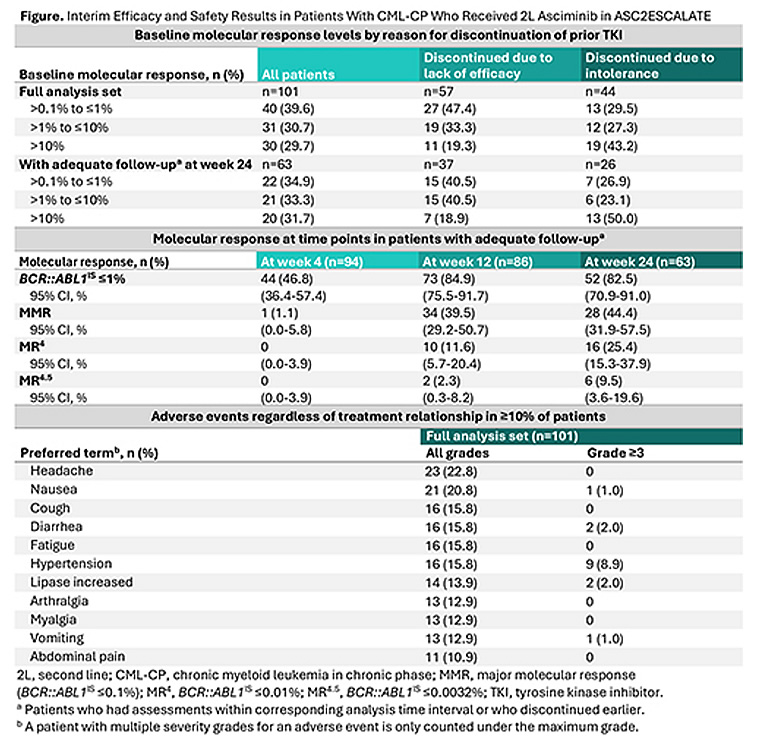
This IA included all 101 pts with CML-CP in 2L (cutoff: Nov 15, 2024). Pts had received prior dasatinib (44.6%), imatinib (42.6%), nilotinib (9.9%), or bosutinib (5.0%) for ≥12 mo (66.3%), ≥6 to <12 mo (15.8%), or <6 mo (17.8%). Pts discontinued prior tx due to lack of efficacy (56.4%) or intolerance (43.6%). Baseline BCR::ABL1IS levels included >0.1% to 1% (39.6%), >1% to 10% (30.7%), and >10% (29.7%; Figure). By the cutoff, 92 pts (91.1%) remained on ASC; 9 pts (8.9%) discontinued ASC due to adverse events (AEs; n=4), pt decision (n=3), or physician decision (n=1) or were lost to follow-up (n=1). Median duration of ASC exposure was 26.1 (range, 6-100) wk. Pts evaluable for all efficacy analyses completed assessments for the respective time point or discontinued earlier (wk 24, n= 63). At wk 24, 82.5% of pts had BCR::ABL1IS ≤1% (Figure). MMR was achieved at wk 24 in 44.4% of pts and was higher in those who discontinued prior tx due to intolerance (57.7%) vs lack of efficacy (35.1%). Deeper responses were also achieved at wk 24, including MR4 (25.4%) and MR4.5 (9.5%). Dose escalation from 80 to 200 mg QD occurred in 7 pts per response level at wk 24 (n=3) and 48 (n=4). Most AEs were grade 1/2 (Figure). Most common all-grade AEs were headache (22.8%) and nausea (20.8%). Grade ≥3 AEs (≥5%) were hypertension (8.9 %), thrombocytopenia (6.9%), and neutropenia (5.9%). AEs led to dose adjustment/interruption in 27 pts (26.7%). AEs led to discontinuation (all before wk 24) in 4 pts; 1 of these AEs occurred >30 d after last ASC dose, and of 3 pts with on-tx events, AEs included grade 3 nausea and vomiting, grade 2 dyspepsia, and grade 2 tremors (n=1 each). No arterial-occlusive events or on-tx deaths occurred. In the first prospective trial of 2L ASC in CML-CP, ASC provided high wk 24 molecular response rates and safety and tolerability consistent with previously established 1L and 3L+ ASC data.
No new or worsening safety signals arose, and AEs led to discontinuation in <5% of pts. These IA results support ASC as a 2L tx option in CML-CP. The impact of dose escalation continues to be explored.
ASC4OPT STUDY: HIGH EFFICACY AND FAVORABLE TOLERABILITY OF ASCIMINIB ONCE OR TWICE DAILY IN CML PATIENTS WITH SUBOPTIMAL RESPONSE, RESISTANCE OR INTOLERANCE OF 2 OR MORE TYROSINE KINASE INHIBITORS
Asciminib (ASC), a BCR::ABL1 inhibitor intentionally designed to Specifically Target the ABL Myristoyl Pocket (STAMP), is approved for the treatment of adult patients (pts) with chronic myelogenous leukemia in chronic phase (CML-CP) previously treated with ≥2 tyrosine kinase inhibitors (TKIs). Clinical and pharmacokinetic studies have shown that 40 mg twice daily (BID) and 80 mg once daily (QD) ASC regimens had similar and substantial efficacy in pts with CML-CP without the T315I mutation. ASC is given under fasting conditions; a QD schedule may improve quality of life and increase treatment adherence. The authors report primary results from the ASC4OPT study. The international, non-comparative ASC4OPT study (NCT04948333) enrolled adults with CML-CP without the T315I mutation and pretreated with ≥2 TKIs.
Eligible pts were not in major molecular response (MMR, treatment failure/warning categories according to ELN 2020 or intolerant to their most recent TKI); pts intolerant to their most recent TKI and in MMR at baseline were also enrolled and analyzed separately. Pts were randomized 1:1 to receive ASC 40 mg BID or 80 mg QD. The primary endpoint was MMR rate at week 48; pts who discontinued earlier were considered as non-responders. For pts in MMR at baseline, MMR rate at week 48 was assessed separately.
A total of 169 patients not in MMR at baseline were randomized to ASC 40 mg BID (n=85) or 80 mg QD (n=84); 1 pt in the 40 mg BID arm did not receive treatment. Patient median age (range) was 55 years (18‒86). Respectively, 49.7%, 29.6%, and 20.1% of pts had received 2, 3, or ≥4 previous TKIs; intolerance was the main reason for discontinuation in 28.4% of pts. At data cutoff (12 March 2024), 136 pts (80.5%) remained on treatment, whereas 5.9% had discontinued ASC due to adverse events (AEs, 6 pts on 40 mg BID and 4 pts on 80 mg QD) and 4.1% due to unsatisfactory therapeutic effect (4 pts on 40 mg BID and 3 pts on 80 mg QD).
Four patients had the T315I mutation detected after enrollment and were excluded from efficacy analyses. MMR rates are shown in the Table. Any-grade and Grade ≥3 AEs were experienced by 89.3% and 29.8% of pts, respectively (90.5% and 25.0% on 40 mg BID, and 88.1% and 34.5% on 80 mg QD, respectively). The rates of AEs leading to treatment discontinuation and to dose reduction or interruption were 6.0% and 30.4%, respectively (7.1% and 29.8% on 40 mg BID, and 4.8% and 31.0% on 80 mg QD, respectively). One on-treatment death was reported (pt on 80 mg QD, due to cerebrovascular accident). In the exploratory cohort of pts in MMR at baseline, 28/30 pts (93.3%; 14/14 [100%] on 40 mg BID and 14/16 [87.5%] on 80 mg QD) maintained MMR at week 48 (Table); 2 pts (80 mg QD arm) discontinued ASC before week 48 due to AEs and were considered non-responders. Of pts in MMR at baseline on 40 mg BID, 3/14 were in MR4 at baseline and 7/14 at week 48; the corresponding numbers for pts on 80 mg QD were 5/16 and 8/16, respectively.

The ASC4OPT findings strengthen those of the ASCEMBL study, supporting ASC as a standard of care for pts with CML-CP pretreated with ≥2 TKIs; the more convenient 80 mg QD regimen may enhance treatment adherence and ultimately improve patient outcomes. Patients who discontinued previous TKIs due to intolerance were able to maintain or deepen responses on ASC regardless of dosing schedule.