IMPACT OF ADVERSE EVENTS ON QUALITY OF LIFE IN CHRONIC MYELOID LEUKEMIA (CML) - RESULTS FROM THE PATIENT SURVEY ON HUMANISTIC BURDEN OF INTOLERANCE TO FIRST OR SECOND TKIS (SHIFT) STUDY IN THE US
David Wei et al.
East Hanover, United States of America
Background
- In chronic myeloid leukemia (CML), tyrosine kinase inhibitor (TKI)-related adverse events (AEs) often result in reduced treatment adherence and medication modifications, including discontinuation.
- The aim of the study is to evaluate the impact of TKI-related AEs on health-related quality of life (QoL) in CML using patient-reported outcomes (PROs) in US clinical practice settings.
Methods
- The SHIFT study is a cross-sectional online survey conducted among patients with CML in the US from June-December 2024. Eligible patients were adults receiving a 1st or 2nd TKI for CML at the time of the survey.
- Data were collected using the Patient-Reported Outcomes version of the Common Terminology Criteria for Adverse Events (PRO-CTCAE) for AEs, and Patient-Reported Outcomes
- Measurement Information System - Global Health (PROMIS-GH-10; lower T-scores indicate poorer health) and the Work Productivity and Activity Impairment Specific Health Problem (WPAI:SHP; higher percentages indicate worse impairment) questionnaires for health-related QoL. Information on "low point(s)" since TKI start, when AEs had the most unpleasant/negative impact on QoL from the patient's perspective, was also collected.
Results
- A final sample of 271 patients (59% female, 80% White, median age 46 years [range: 18-82]) was included in the study. Half were employed (52%; 18% not employed, 17% retired, 7% on disability) and received care in a community-based setting (54%; 41% academic). Over half had been on their current TKI for ≥ 1 year (54%), with 60% on their 1st, 40% on their 2nd TKI. TKIs utilized included imatinib (34%), dasatinib (37%), bosutinib (14%), nilotinib (12%), or ponatinib (3%).
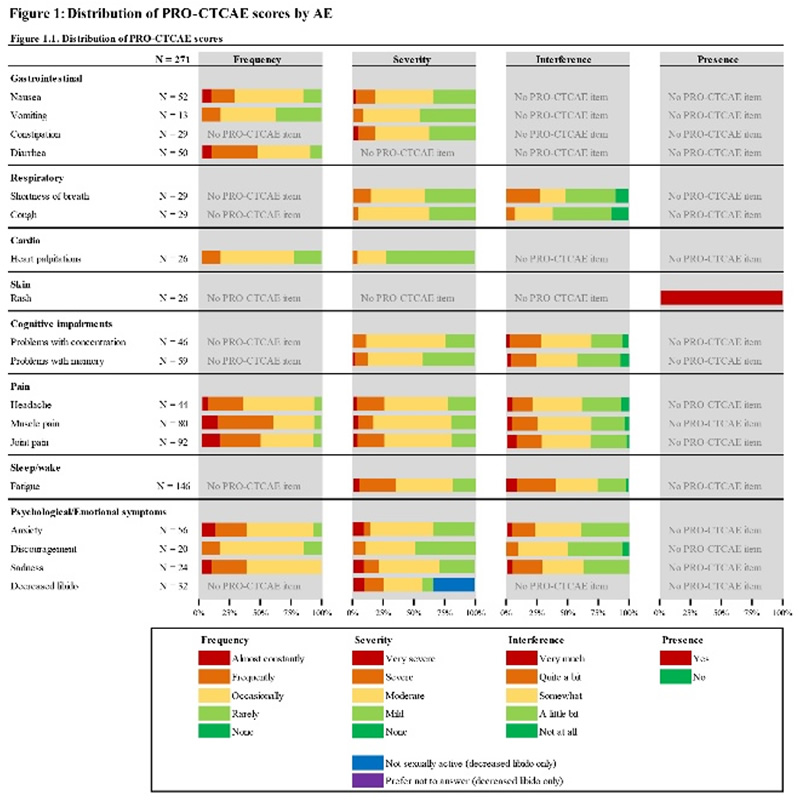
- Patients reported a median of 3 AEs (range: 0-14) in the last 7 days. Most common AEs (Figure 1) were: fatigue (54%), joint pain (34%), muscle pain (30%), problems with memory (22%), and anxiety (21%). Most experienced chronic AEs (80%) in the last 7 days on their current TKI. The majority (77%) experienced ≥ 1 "low point(s)" since starting their TKI, with 23% occurring in the last 7 days. "Low points" mainly occurred within the first 3 months of starting a TKI (55%).
- Mean ± SD PROMIS-GH-10 Global Physical Health (GPH) and Global Mental Health (GMH) T-scores were 42.6 ± 7.0 and 44.4 ± 7.7, respectively, indicating worse health than the general population (mean 50 ± 10). Both GPH and GMH T-scores were worse among patients experiencing ≥1 "low point(s)" in the last 7 days (GPH: 37.3 ± 6.2; GMH: 38.1 ± 7.6).
- Mean percent activity impairment due to CML was 37.3%. About two-thirds (60%) had a change in employment due to CML: 14% from full-time to part-time, 13% from full-time to unemployed, 10% took early retirement, 7% stopped working temporarily/reduced workload. Of those employed, mean percent work productivity loss, impairment while working (presenteeism), and work time missed (absenteeism) due to CML were 32.7%, 29.0%, and 9.8%, respectively.
Conclusion
- Findings from the SHIFT study demonstrate the substantial humanistic burden of TKI-related AEs among patients with CML in the US. Most patients had multiple persistent AEs, negatively impacting physical and mental health, contributing to worse QoL.
- In addition, the extent of work productivity impairment is reflected in the high proportion modifying employment due to CML and, among those employed, experiencing some work productivity loss. Treatment options with better tolerability are needed to reduce AEs and help patients with CML preserve QoL.