
NEW PEDIATRIC FORMULATION OF ASCIMINIB IN CHILDREN WITH CHRONIC MYELOID LEUKEMIA IN CHRONIC PHASE: SECOND INTERIM ANALYSIS OF PHARMACOKINETICS, SAFETY AND GROWTH DATA FROM THE ASC4KIDS STUDY
Markus Metzler et al.
Department of Pediatrics and Adolescent Medicine, University Hospital Erlangen, Erlangen, Germany
Background
- Pediatric patients (pts) with Philadelphia chromosome-positive (Ph+) chronic myeloid leukemia in chronic phase (CML-CP) require more treatment (tx) options with enhanced efficacy, long-term safety and no detrimental effect on growth.
- Asciminib (ASC) is the first BCR::ABL1 inhibitor that Specifically Targets the ABL Myristoyl Pocket (STAMP), approved for adults with newly diagnosed (US) or pre-treated CML-CP (≥2 tyrosine kinase inhibitors [TKIs], worldwide).
- The phase Ib/II ASC4Kids study (NCT04925479) aims to assess the pharmacokinetic (PK), safety and efficacy profile of ASC in pediatric pts.
Methods
- This multi-center, open-label study included pts aged 1-<18 years (yrs) with Ph+ CML-CP, without the T315I mutation, treated with ≥1 prior TKIs.
- The primary endpoint is to characterize the PK profile of ASC in pediatric pts and confirm a pediatric formulation (PF) dose (fed) that leads to an ASC exposure comparable to that of the adult formulation dose (AF, 40 mg twice daily [BID], fasted). Secondary endpoints are safety and molecular responses. In an exploratory group, pts 14‒<18 yrs old were treated with the AF dose (fasted).
- In Part 1, pts received PF at an initial dose of 1.3 mg/kg BID (fed) to evaluate exposure (measured by area under the curve from dosing to the time of the last measured concentration [AUClast] and maximum plasma concentration [Cmax]) and dose-limiting toxicities (DLTs) over the first 28 days of tx.
- In Part 2, additional pts (10 pts per group across Parts 1+2: 1‒<12 yrs and 12‒<18 yrs) were treated with the confirmed PF dose of 1.3 mg/kg BID from Part 1 for further evaluation.
- In Part 3, 10 more pts will be enrolled (5 pts per age group), who will receive PF 2.6 mg/kg once daily (QD, fed). This interim analysis was completed once all pts in Part 1+2 for the PF group (12‒<18 yrs) had completed 28 days of tx.
Results
- Nineteen pts were enrolled in the PF group (7 in 1‒<12 yrs and 12 in 12‒<18 yrs groups, respectively). All pts were ongoing tx at the second interim data cutoff (19 Aug 2024). Median duration of exposure was 36.7 weeks.
- Ten pts were evaluable for PK for the PF group (12‒<18 yrs). When compared to adult studies, averaged ASC exposure with PF 1.3 mg/kg BID (fed) was similar (median AUClast: 5130 vs 7091 hr*ng/mL; median Cmax: 939 vs 1031 ng/mL, respectively).
- Almost all pts (94.7%) experienced adverse events (AEs; any grade); most common AEs (≥3 pts) were vomiting (6 pts, 31.6%) and upper respiratory tract infection (4 pts, 21.2%). Grade ≥3 AEs were leukopenia/neutropenia and abdominal pain (1 pt each). AEs leading to dose interruption occurred in 3 pts. No Grade 4 AEs, serious AEs, DLTs or AEs leading to discontinuation were reported.
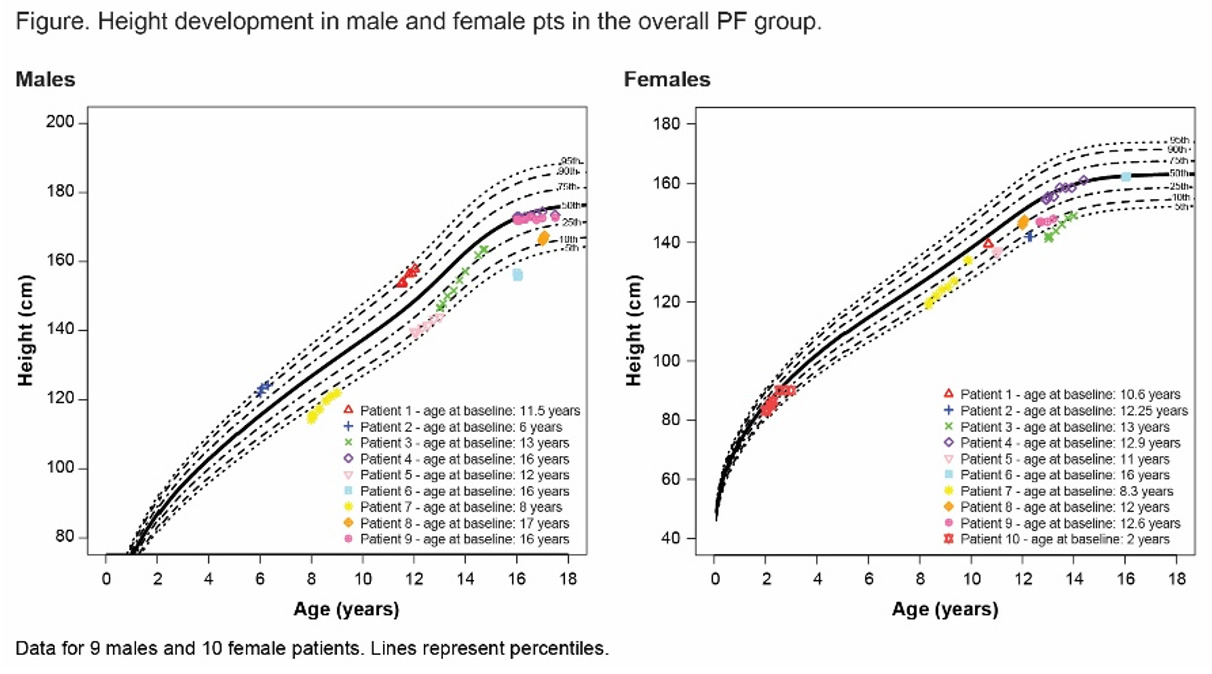
- Individual height percentile shift from baseline (BL) to data cutoff for the overall PF group was assessed; 9 pts stayed in the same percentile, 6 increased and 4 dropped. Height development in both male and female pts was not delayed by ASC (Figure). Four of 19 pts had notably low bone age at BL; 3 of these also at Week 52.
- At BL,16/18 pts in the PF group had BCR::ABL1IS ≤10%; 6 were in major molecular response (MMR, BCR::ABL1IS ≤0.1%). Of pts evaluable at Weeks 28 and 40, 10/11 and 9/9 pts had BCR::ABL1IS ≤1%, 7/11 and 6/9 pts were in MMR, respectively.
Conclusion
- The PF dose of 1.3 mg/kg BID was well tolerated and showed evidence of efficacy in a larger cohort of children, with no new safety signals. Preliminary data shows ASC did not negatively impact growth. A 2.6 mg/kg QD dose will be assessed in Part 3.