
EMATOLOGIA
MPN — Giugno 2025
- CLINICAL OUTCOMES IN PATIENTS WITH MYELOFIBROSIS TREATED WITH RUXOLITINIB AND ANEMIA SUPPORTING MEDICATIONS
- IMPACT OF ELN CLINICAL SIGNS AND SYMPTOMS ON OUTCOMES IN POLYCYTHEMIA VERA PATIENTS TREATED WITH HYDROXYUREA OR RUXOLITINIB: A COOPERATIVE STUDY
- PELABRESIB IN COMBINATION WITH RUXOLITINIB FOR JANUS KINASE INHIBITOR-NAIVE PATIENTS WITH MYELOFIBROSIS: 72-WEEK FOLLOW-UP WITH LONG-TERM EFFICACY OUTCOMES OF THE PHASE III MANIFEST-2 STUDY
- RETROSPECTIVE ANALYSIS OF EFFICACY AND SAFETY OUTCOMES IN PATIENTS WITH PRIMARY AND SECONDARY MYELOFIBROSIS TREATED WITH RUXOLITINIB: JUMP STUDY
- CLINICAL PATHWAYS AND PROGNOSTIC STRATEGIES IN MYELOFIBROSIS: A REAL-WORLD ANALYSIS OF GERMAN PRACTICE
- HEALTH-RELATED QUALITY OF LIFE AND SYMPTOM BURDEN IN PRE-FIBROTIC AND OVERT MYELOFIBROSIS COMPARED TO THE GENERAL POPULATION AND PHYSICIAN PERCEPTIONS: RESULTS FROM THE GIMEMA-PROPHECY STUDY
- A DELPHI CONSENSUS TO DEFINE DISEASE PROGRESSION AND DISEASE MODIFICATION IN POLYCYTHEMIA VERA
- LYMPHOCYTE TO MONOCYTE RATIO MAY PREDICT TRANSFORMATION TO MYELOFIBROSIS FOR POLYCYTHEMIA VERA PATIENTS TREATED WITH RUXOLITINIB: EXPERIENCE FROM MAJIC-PV TRIAL

CLINICAL OUTCOMES IN PATIENTS WITH MYELOFIBROSIS TREATED WITH RUXOLITINIB AND ANEMIA SUPPORTING MEDICATIONS
Patients with myelofibrosis often present with anemia, and dose-dependent anemia is a consequence of treatment with the Janus kinase (JAK)1/JAK2 inhibitor ruxolitinib.
Erythropoiesis-stimulating agents (ESAs) and danazol are recommended options to manage anemia in this population. However, data are lacking regarding clinical outcomes of patients with myelofibrosis treated with ruxolitinib and these agents. This post hoc analysis of the large phase 3b JUMP trial evaluated treatment patterns and clinical outcomes of patients treated with ruxolitinib and ESAs or danazol.
The large (N=2233), single-arm, phase 3b, expanded-access JUMP trial run by Pankit Vachhani et al. evaluated safety and efficacy of ruxolitinib for patients with myelofibrosis in a setting similar to routine clinical practice. JUMP included adults with primary or secondary myelofibrosis and baseline platelets ≥50×109/L. Ruxolitinib starting dose was 5-20 mg twice daily based on baseline platelet count. This analysis included patients with baseline anemia (hemoglobin <12.0 g/dL [Hb<12] or an Hb<10.0 g/dL subset [Hb<10]) who were not receiving anemia medication at enrollment but initiated ESA/danazol within 3 months of enrollment and remained on therapy for ≥3 months. Clinical outcomes evaluated were spleen length response and symptom response.
Of the 1384 patients with Hb<12 (755 with Hb<10) not receiving supportive care for anemia at enrollment, 101 (7.3%) initiated an ESA (n=98) or danazol (n=3) within 3 months of enrollment (52 [6.9%] with Hb<10) and were included in this analysis. For the Hb<12 cohort, median (range) age was 70 (45-86) years, 54% were male, median (range) myelofibrosis duration since initial diagnosis was 19 (0.3-312) months, 91% had a palpable spleen, and median (range) time from enrollment to first dose of an ESA/danazol was 43.0 (2-91) days. For the Hb<10 subset, median (range) age was 72 (45-84) years, 52% were male, median (range) myelofibrosis duration since initial diagnosis was 13 (0.3-158) months, 89% had a palpable spleen, and median (range) time from enrollment to first dose of ESA/danazol was 34 (2-90) days. Spleen length response and symptom response rates are reported in Table 1. For both the Hb<12 cohort and Hb<10 subset, mean Hb during the study reached a nadir at Week 4 and steadily increased thereafter to Week 48 (Hb<12 mean 1.5% change from baseline, Hb<10 mean 6.5% change from baseline). Mean (SD) ruxolitinib total daily dose decreased from baseline (Hb<12, 35 [9] mg; Hb<10, 34 [9] mg) to Weeks 45-48 (Hb<12, 25 [11] mg; Hb<10, 25 [11] mg). Mean number of transfusions decreased from baseline (1.0) to Week 48 (0.6) in the Hb<10 subset.

For patients with anemia at myelofibrosis diagnosis who received ESA/danazol in combination with ruxolitinib, spleen and symptom responses were similar to those reported in the entire JUMP study population. In addition, most patients tolerated doses of ruxolitinib >25 mg daily and post-enrollment maintained an Hb level within 1.0 g/dL of baseline throughout the study period. These results reinforce the use of supportive care for anemia with an ESA/danazol combined with ruxolitinib and may allow for maintenance of ruxolitinib dose intensity in myelofibrosis patients with anemia.
IMPACT OF ELN CLINICAL SIGNS AND SYMPTOMS ON OUTCOMES IN POLYCYTHEMIA VERA PATIENTS TREATED WITH HYDROXYUREA OR RUXOLITINIB: A COOPERATIVE STUDY
ELN-defined clinical signs and symptoms (CSSs) identify an increased thrombotic risk phenotype in Polycythemia vera (PV) patients (pts) treated with hydroxyurea (HU) in low-risk (LR, age <60 years & no previous thromboses) and high-risk (HR, age>60 years and/or previous thrombosis) categories (Palandri et al, Blood2024; 144(S1): 242). Whether CSSs may influence the outcome of PV pts is still unclear. This study conducted by Francesca Palandri et al. evaluates, in PV pts treated with 1st-line HU or 2nd-line ruxolitinib (RUX): 1) the incidence ratio rates (IRRs) of thromboses and of disease progression including secondary myelofibrosis/acute leukemia (SMF/AL) across LR and HR categories; 2) the impact of CSSs on the risk of disease progression.
The PV-ARC is a multicenter study of 1197 WHO2022 PV pts (NCT06134102). Among these, 739 HU-treated and 254 RUX-treated were evaluated for CSSs at therapy start. IRRs of events occurring during HU/RUX therapy were calculated per 100 patient-years (%p-y).
Thrombosis-free (TFS) and progression-free survival (PFS) were assessed using KM analysis from HU or RUX start adjusted for delayed entry. CSSs associated with disease progression were analyzed by uni/multivariate (MVA) Cox regression analysis. Overall, 189 pts were LR (18.5% of HU pts and 20.5% of RUX pts). CSSs were identified in 443 (60.0%) HU pts and in 165 (65.0%) RUX pts, comparably across risk categories in both cohorts. Mean HU and RUX duration was 5.7 and 3.2 yrs, respectively. The IRRs of thrombosis was numerically superior (1.7 vs 1 %p-y) and the IRR of progression was statistically inferior (1.6% vs 4.2%p-y, p<0.001) in the HU compared to the RUX cohort.In both cohorts, the IRRs of thrombosis and progression were comparable across conventional risk categories. This was confirmed in the pooled analysis of LR (n. 189) and HR (n. 804) pts irrespective of treatment (p=0.12 for thrombosis and p=0.36 for disease progression).
In the HU cohort, the presence of CSSs significantly influenced the risk of thrombosis (2.2 vs 0.7%p-y in pts without CSSs, p<0.001), while disease progression was comparable (1.7 vs 1.3%p-y, p=0.38). This was confirmed both in the LR and HR category. In RUX pts, CSSs were significantly associated with an increased risk of both thrombosis (1.5 vs 0%p-y in pts without CSSs, p=0.04) and of disease progression (5.3 vs 2.2%p-y, p=0.04). This was confirmed in the HR category (CSSs vs no CSSs: thrombosis, 1.7 vs 0%p-y, p=0.05; disease progression, 5.7 vs 1.4 %p-y, p=0.01).
TFS at 5 yrs was 88.7% (HU) and 95.4% (RUX) in pts with CSSs compared to 96.1% and 100% in those without CSSs (p<0.001), while PFS at 5-yrs was 94.4% (HU) and 74.9% (RUX) in pts with CSSs compared to 97.2% and 90.0% in those without CSS (p<0.001) (Figure 1).
By MVA Cox regression analysis including individual CSSs, predictors of disease progression were progressive splenomegaly in the HU group (HR: 5.3, 95%CI 1.9-14.6, p=0.002) and persistent/progressive leukocytosis in the RUX group (HR: 1.93, 95%CI 1.0-3.6, p=0.045).

Conventional risk stratification failed to identify pts at higher risk of thrombosis or disease progression both during HU and RUX. Conversely, ELN CSSs had a potent prognostic role in the thrombotic risk in both cohorts; moreover, CSSs were significant predictors of disease progression into SMF/AML in advanced-stage patients requiring a 2nd-line with RUX. CSSs evaluation may enhance outcome risk stratification and inform therapeutic decisions.
PELABRESIB IN COMBINATION WITH RUXOLITINIB FOR JANUS KINASE INHIBITOR-NAIVE PATIENTS WITH MYELOFIBROSIS: 72-WEEK FOLLOW-UP WITH LONG-TERM EFFICACY OUTCOMES OF THE PHASE III MANIFEST-2 STUDY
Myelofibrosis (MF) is a progressive and life-threatening disease characterized by splenomegaly, cytopenias, debilitating symptoms, and bone marrow fibrosis (BMF). While Janus kinase inhibitors are the standard of care for intermediate- (Int-) and high-risk MF, there is a need for more effective treatments.
Pelabresib (PELA) is an investigational, oral, small molecule drug that inhibits BET proteins and subsequent BET-mediated expression of genes involved in MF pathogenesis. The Phase III MANIFEST-2 study (NCT04603495), evaluating the efficacy and safety of PELA plus ruxolitinib (RUX) in patients (pts) with MF, met its primary endpoint.
The aim of this study is to report efficacy and safety data from MANIFEST-2 at Week 72, including progression-free survival (PFS), overall survival (OS), and leukemia-free survival (LFS).
Eligible pts had a Dynamic International Prognostic Scoring System ≥ Int-1 risk, platelet count ≥100 × 109/L, spleen volume ≥450 cm3, ≥2 symptoms with an average score ≥3 or total symptom score (TSS) ≥10 (Myelofibrosis Symptom Assessment Form v4.0), peripheral blast count <5%, and Eastern Cooperative Oncology Group performance status ≤2.
Pts provided informed consent and were randomized 1:1 to PELA+RUX or placebo (PBO)+RUX. SVR35 (≥35% reduction in spleen volume from baseline [BL]), absolute change in TSS, and TSS50 (≥50% reduction in TSS from BL) were assessed at 72 weeks. Hemoglobin (Hb) response (≥1.5 g/dL mean increase in Hb from BL in the absence of transfusion during the prior 12 weeks), BMF grade at 72 weeks, and safety were also assessed. Longer-term analyses were conducted for PFS (time from randomization to documented progression, or death from any cause), OS, and LFS, although the study was not powered for survival outcomes.
As of 30-Aug-2024, 67.8% (145/214) of pts in the PELA+RUX arm and 72.7% (157/216) of pts in the PBO+RUX arm remained on study, with a median follow-up of 92 weeks. SVR35 response, absolute change in TSS, and BMF improvement of ≥1 grade were in favor of PELA+RUX and are summarized in the table. In pts with anemia (Hb BL <10 g/dL), Hb response was observed in 20.9% (14/67; 95% CI: 11.16-30.63) vs 16.9% (12/71; 95% CI: 8.18-25.62) of pts in the PELA+RUX arm vs the PBO+RUX arm. Of 426 pts evaluable for safety, Grade ≥3 treatment-emergent adverse events (TEAEs) were reported in 65.1% vs 65.4%, and Grade ≥3 anemia and thrombocytopenia in 27.4% vs 41.1% and 17.0% vs 7.0% in the PELA+RUX arm vs the PBO+RUX arm, respectively. Accelerated- and blast-phase progression, adjudicated independently by external experts, was reported in 6.1% (13/214) of pts in the PELA+RUX arm and in 4.2% (9/214) of pts in the PBO+RUX arm. Comparing PELA+RUX vs PBO+RUX, the PFS hazard ratio (HR) was 0.874 (95% CI: 0.49-1.56), OS HR 0.932 (95% CI: 0.53-1.66), and LFS HR 0.994 (95% CI: 0.57-1.72).

PELA+RUX showed sustained improvements over 72 weeks in splenic response, symptoms, SVR35/TSS50 dual response, BMF, and anemia vs PBO+RUX. The safety profile for Grade ≥3 TEAEs was similar and consistent across treatment arms, with the imbalance in leukemic transformation cases decreasing over time. Survival outcomes show a trend in favor of the PELA+RUX arm. Overall findings suggest that PELA+RUX provides meaningful clinical benefits over RUX alone, with correlative biomarkers supporting evidence of ongoing disease modification, and potential for improving survival in pts with MF.
RETROSPECTIVE ANALYSIS OF EFFICACY AND SAFETY OUTCOMES IN PATIENTS WITH PRIMARY AND SECONDARY MYELOFIBROSIS TREATED WITH RUXOLITINIB: JUMP STUDY
Ruxolitinib (RUX) has been shown to provide spleen, symptom and overall survival (OS) benefits in patients (pts) with myelofibrosis (MF). Evidence from real-world data indicates that pts with secondary MF (SMF) are less frequently treated with Janus Kinase (JAK) inhibitors such as RUX in clinical practice.
The phase IIIb, single arm, open-label JUMP study assessed the safety and efficacy of RUX in pts with symptomatic MF without access to RUX outside of a clinical trial setting. This analysis aimed to compare efficacy and safety of RUX in pts diagnosed with primary MF (PMF) and SMF, differentiating also between two types of SMF: post-polycythemia vera (PV) and post-essential thrombocythemia (ET).
This was a retrospective analysis of 2232 pts in the JUMP study; 1326 had a PMF diagnosis, 532 a post-PV diagnosis, and 374 a post-ET diagnosis.
Outcomes included spleen length response, progression-free survival (PFS), leukemia-free survival (LFS), OS, patient-reported outcomes (FACIT-fatigue score) and incidence of adverse events (AEs). Spleen length response (defined as a ≥50% reduction in a post-baseline [BL] visit) and best response (defined as largest percentage reduction in spleen length achieved at any time) were compared by logistic and linear regression, respectively, of the response variable against diagnosis, adjusting for confounders. FACIT-fatigue score (with response defined as ≥3 point increase from BL) was also compared using logistic regression.
PFS, LFS and OS were compared using a Cox proportional hazards regression analysis adjusting for confounders to calculate hazard ratios and 95% confidence intervals for each diagnosis group. Confounders included age, gender, BL spleen length, BL hemoglobin (Hb), BL blast cells and BL white blood cells (WBCs), prior use of MF medications and BL FACIT-fatigue score for FACIT-related analysis. Models were repeated for PMF vs SMF diagnosis and further differentiating by SMF type. Incidences of AEs were descriptively analyzed. The mean age was 66.1 vs 65.0 years for PMF vs SMF, respectively. Proportions of female pts (40.6% vs 51.8%) as well as BL levels of Hb, platelets and WBCs were lower, and there was a longer mean time between MF diagnosis and treatment start (54.9 vs 47.2 months) for the PMF vs SMF group, respectively.
Similar outcomes for RUX across diagnoses were observed for spleen response, fatigue reporting, and survival, and only minimal differences in AE profile were seen between pts with PMF and SMF, or when further differentiating by SMF type (Table). For spleen response, pts with SMF were as likely to respond to RUX and had a similar best response to pts with PMF, and when differentiating by SMF type. Mean FACIT-fatigue scores were similar between diagnosis at BL (PMF: 33.0, post-PV: 32.6 and post-ET: 31.8) and at Week 48 (36.9, 38.0 and 36.3, respectively).
FACIT-fatigue score mean improvement from BL to Week 48 was comparable between PMF and SMF; however, it was slightly lower for post-ET when differentiating by SMF type (PMF: 25.1%, post-PV: 24.5% and post-ET: 18.7%). A >5% increase in the incidence of any grade asthenia, and a >5% decrease for Grade 3/4 anemia was observed in post-ET pts, and in SMF and post-PV pts, respectively, compared to PMF pts.

RUX shows comparable effects across multiple outcome measures in pts diagnosed with both PMF and SMF. The findings support that, as for PMF, RUX is a viable treatment option for SMF regardless of SMF type.
CLINICAL PATHWAYS AND PROGNOSTIC STRATEGIES IN MYELOFIBROSIS: A REAL-WORLD ANALYSIS OF GERMAN PRACTICE
Myelofibrosis (MF) is a rare chronic myeloproliferative neoplasm characterized by bone marrow fibrosis, splenomegaly, and cytopenias. Treatment focuses on symptom management, with disease-modifying options limited outside of allogeneic stem cell transplantation (SCT).
Real-world MF management varies, and data from Germany remain scarce. This study examined treatment pathways and clinical outcomes for MF patients (pts) in routine German clinical practice. The aim of this study is to evaluate real-world management patterns of MF in Germany, focusing on JAK inhibitor use, prognostic scoring, cytogenetic testing, anemia management, and treatment sequencing. A retrospective chart review was conducted across multiple German institutions, examining diagnosed MF patients treated between 2017 and 2022. Data on demographics, clinical characteristics, treatment patterns, and outcomes were collected, with analyses focusing on cytogenetic testing, prognostic scoring, and treatment modifications.
Among 350 MF pts, 59 were under watch & wait, and 291 received therapy. Of these, 24 underwent non-drug therapies (SCT, radiation, splenectomy), while 267 received drug therapy. At initial diagnosis, median age was 68, with comorbidities including hypertension (40%), coronary heart disease (15%), diabetes (14%), and heart insufficiency (9%). Splenomegaly was present in 75%, and anemia in 54%. Cytogenetic testing was performed in 70%, with JAK2 V617F mutations detected in 96% of tested pts. Prognostic scoring usage was as follows: IPSS (22%), DIPSS (18%), DIPSS-plus (10%), MIPSS70-plus (4%), and MIPSS (2%). Post hoc calculations identified 25% as intermediate-high risk at diagnosis, rising to 33% among ruxolitinib (rux)-treated pts. Median time from diagnosis to treatment initiation was 1.6 months, and from 1L to 2L 12.5 months. JAK inhibitors were preferred across all lines, with rux most common (72% in 1L). Hydroxyurea was used in 28% of 1L pts, mainly those with minimal or no splenomegaly. In 2L, rux remained dominant (59%), followed by fedratinib (26%), mainly in JAKi-to-JAKi sequencing.
Among 210 rux-treated pts, 154 received therapy for ≥24 weeks. Extended treatment breaks were rare (4%), with dose reductions being the main strategy for tolerability (27%). Anemia was a key reason for dose reduction (46%). Pts with dose reductions were less likely (12%) to have received erythrocyte transfusions prior to treatment compared to those without (31%). TTNT analysis showed prolonged TTNT1 for rux-treated 1L pts compared to non-JAKi-treated pts. Among 1L rux-treated pts, key therapeutic goals achieved included spleen size reduction (60%), hemoglobin improvement (39%), better thrombocyte count (35%), and reduced transfusion dependency (23%), highlighting its role in disease control.
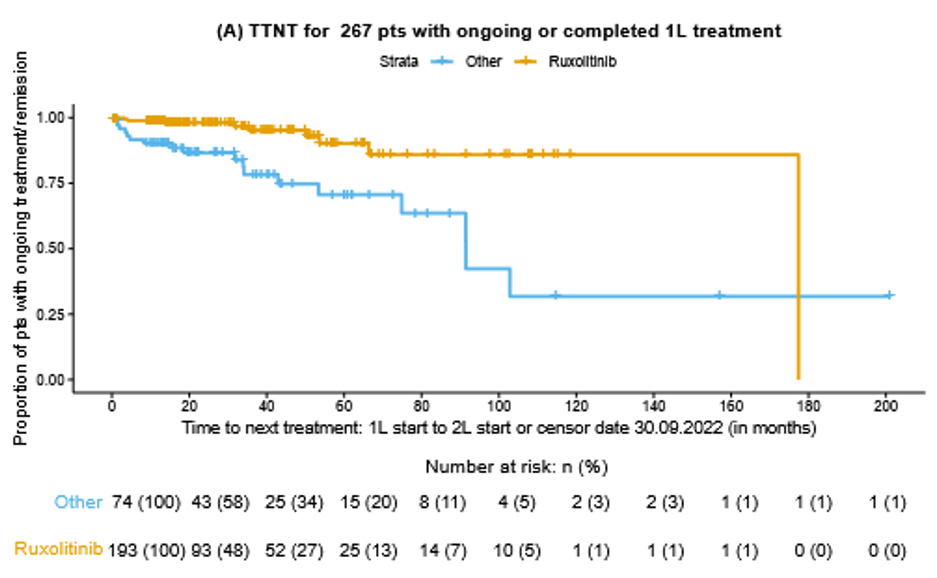
Real-world MF management in Germany favors JAK inhibitors, especially rux, across treatment lines. Despite guidelines, traditional prognostic scores dominate, highlighting the need for broader adoption of molecular risk stratification, as cytogenetic testing is commonly used. Treatment modifications due to anemia are frequent, with dose reductions preferred over discontinuation. Many 2L pts continue JAK inhibitors, with fedratinib emerging after rux, reflecting the rise of JAKi-to-JAKi sequencing. These findings emphasize the need for optimized anemia management and further evaluation of treatment sequencing. Future studies should assess the long-term impact of JAKi sequencing on disease progression and survival.
HEALTH-RELATED QUALITY OF LIFE AND SYMPTOM BURDEN IN PRE-FIBROTIC AND OVERT MYELOFIBROSIS COMPARED TO THE GENERAL POPULATION AND PHYSICIAN PERCEPTIONS: RESULTS FROM THE GIMEMA-PROPHECY STUDY
The symptom burden and deterioration of health-related quality of life (HRQoL) in overt primary myelofibrosis (overt-PMF) are well-documented. In contrast, the impact of pre-fibrotic myelofibrosis (pre-PMF) remains unclear. Preliminary data showed significant HRQoL impairment in pre-PMF patients, but comparisons with the general population warrant further investigation.
This subgroup analysis compares HRQoL in patients with pre-PMF and overt-PMF to that of the general population. It also seeks to assess the symptom burden reported by patients and documented by physicians in both disease stages. Baseline data from patients with MF enrolled in the PROPHECY study of the GIMEMA Foundation were analyzed. HRQoL was assessed using the EORTC QLQ-C30 questionnaire, which includes 5 functional scales: physical (PF), role (RF), emotional (EF), cognitive (CF), and social (SF); 3 symptom scales: fatigue (FA), nausea/vomiting (NV), and pain (PA); 6 single-item scales: dyspnea (DY), sleep disturbance (SL), appetite loss (AP), constipation (CO), diarrhea (DI), and financial impact (FI); and the global health status/QoL (QL) scale.
The prevalence and severity of symptoms reported by patients and perceived by clinicians were evaluated using the 10-item MPN-SAF TSS questionnaire. Significant differences in HRQoL between groups (pre-/overt-PMF and the general population) were assessed according to predefined thresholds (Cocks K. et al., J Clin Oncol 29:89-96, 2011). Analyses were adjusted for sex, age, and comorbidities.
A total of 137 PMF patients were enrolled across 21 Italian centers from June 2022 to November 2023. The median age was 68.5 years. At baseline, splenomegaly was present in 46% of patients, 38.7% had at least one comorbidity, and 17.8% had a history of prior thrombotic events. A total of 82 patients were diagnosed with overt-PMF and 55 with pre-PMF. Compared to the general population, a clinically significant difference emerged for pre-PMF patients in the following EORTC QLQ-C30 scales: PF (mean difference (Δ) =-9.0), RF (Δ =-10.3), CF (Δ =-4.5), as well as for FA (Δ =8.7), DY (Δ =7.1), and FI (Δ =-3.9).
Differences were also observed in overt-PMF patients compared to the general population, particularly for RF (Δ =-20.9), PF (Δ =-11.6), SF (Δ =-8.2), CF (Δ =-7.1), QL (Δ =-9.2) and FA (Δ =13.4), and less markedly for SL (Δ =5.7) and AP (Δ =5.1). The overall symptom burden was high, as assessed by the MPN-SAF TSS. Although generally more severe in overt-PMF, symptoms were also frequent in pre-PMF. FA, abdominal discomfort, concentration problems, and bone pain were more frequent in pre-PMF. Additional analyses based on 116 patient-physician paired MPN-SAF TSS questionnaires, showed that physicians generally underestimated symptom severity, with early satiety and itching showing the most notable discrepancies (Figure 1).

The extended data analysis confirms a similar symptom burden between overt-PMF and pre-PMF. Clinically significant differences were observed in both conditions compared to the general population. The observed misalignment between physician- and patient-reported symptoms underscores the need for a more nuanced approach to evaluating the overall burden of the disease and treatment experienced by these patients.
A DELPHI CONSENSUS TO DEFINE DISEASE PROGRESSION AND DISEASE MODIFICATION IN POLYCYTHEMIA VERA
Polycythemia vera (PV) is a chronic myeloproliferative neoplasm characterized by clonal erythrocytosis but often also involves leukocytosis and thrombocytosis. These features have been linked to an increased risk of thrombosis and shorten patient survival. Approximately 10-20% of PV cases eventually progress to Post-PV myelofibrosis, with a further 3% undergoing transformation to acute myeloid leukemia. Risk factors associated with the progression include advanced age, leukocytosis and the presence of high-risk molecular mutations.
A more concise definition of disease progression in PV is essential when evaluating treatment options that have the potential for disease modification and the improvement of patient outcomes. Developing a consensus definition for disease progression in PV is crucial for evaluating effective therapeutic strategies in prospective studies. The aim of this study is t define disease progression and modification in PV.
A modified-Delphi method was used to convene a virtual steering group of seven US-based clinical experts (Prithviraj Bose et al.), in the management and treatment of PV and this group generated 41 consensus statements across six main domains: 1) Treatment goals for patients with PV; 2) Selecting treatment for patients with PV; 3) Defining and assessing disease modification; 4) Recognizing suboptimal response, intolerance, or resistance to treatment; 5)Defining and assessing disease progression and 6) Optimally engaging patients with PV.
A survey was developed from these statements and shared with a broader panel of specialists, using a four-point Likert scale. The results were analyzed to determine the level of agreement for each statement. Consensus threshold was set at 75% agreement, defined as strong consensus, with ≥90% agreement considered very strong consensus. A total of 61 responses were received from the following specialists: hematologist-oncologists (n=56), oncologists (n=3), and hematologists (n=2). On analysis of the consensus statements, 39/41 (95%) statements achieved consensus agreement, and 2/41 (5%) failed to achieve consensus. Consensus statements related to response assessment selection and disease progression scored the highest with 92% consensus among the experts.
Based on the agreement levels achieved, the steering group members agreed on a set of recommendations for defining disease progression and disease modification in PV.
These recommendations are expected to play an important role in better understanding of the disease course.

LYMPHOCYTE TO MONOCYTE RATIO MAY PREDICT TRANSFORMATION TO MYELOFIBROSIS FOR POLYCYTHEMIA VERA PATIENTS TREATED WITH RUXOLITINIB: EXPERIENCE FROM MAJIC-PV TRIAL
Polycythaemia vera (PV), a chronic myeloproliferative disorder, is caused by mutations affecting JAK2. Here, disease-related complications such as thrombosis as well as disease progression are thought to be linked to inflammation, driving cellular proliferation and fibrosis. Prior work suggests that blood cell ratios, reflecting immune system dysfunction and inflammation, such as neutrophil-to-lymphocyte (NLR), lymphocyte-to-monocyte (LMR), and monocyte-to-platelet (MPR), may serve as potential prognostic markers for PV. In this analysis, we utilize data from the prospective MAJIC-PV trial, and examine the effect of ruxolitinib compared with best available therapy (BAT) upon the predictive power of these ratios upon clinically relevant endpoints such as thrombosis, disease transformation, and achieving a clinical haematological or molecular response.
The authors (A. Duminuco et al.) used descriptive analysis to look at the trends of ratios and the number of thrombotic events, disease transformations, molecular and clinical response. Ratios were transformed onto the log scale to mitigate the impact of outliers. A ROC analysis was conducted on all ratios for each treatment arm to determine the optimal thresholds for predicting specific events. Aligning with good practice, only thresholds with both sensitivity and specificity >0.8 were considered.
A total of 180 patients were recruited into the MAJIC PV study; 93 received ruxolitinib and 87 BAT, and the primary results were published (JCO 2023:3534-3544). After the ROC analysis, no ratio met the ideal specificity and sensitivity threshold of 0.8 for predicting any prespecified events, except for transformation. In MAJIC-PV the most common transformations were myelofibrosis (PPV-MF), with 10 in the BAT and 5 in the ruxolitinib arm, followed by 1 case of myelodysplasia (MDS) (BAT arm) and 4 cases of acute leukemia (AML) (all in the ruxolitinib arm). For all transformations (PPV-MF and AML/MDS), the LMR taken at 6 months for patients on ruxolitinib was 0.567, and was close to significance with a sensitivity of 0.750 and a specificity of 0.848. Focusing only upon PPV-MF, LMR in patients treated with ruxolitinib met the predictive threshold both at baseline and after six months. Here at baseline, a LMR of 0.458 had a specificity of 0.805, sensitivity of 0.8, and an accuracy of 0.804, and at six months, a LMR of 0.567 achieved a specificity of 0.831, sensitivity of 1, and an accuracy of 0.839. The thresholds for ratios predicting PPV-MF transformation from baseline (A) and 6 months (B) are reported in Table 1. Finally, whilst no ratio demonstrated strong predictive power for achieving a partial molecular response, which was associated with survival benefit, the six-month NLR approached the threshold with a specificity of 0.800 and sensitivity of 0.778 for patients treated with BAT.

This first analysis in a prospective randomized study suggests a possible role for LMR in ruxolitinib-treated PV patients at baseline and six months to predict transformation to PPV-MF. If confirmed in further studies, this could potentially be of clinical importance in the choice of therapy.