

ASC4FIRST WK 144 ANALYSIS: CONTINUED SUPERIOR EFFICACY AND FAVORABLE SAFETY OF ASCIMINIB VS INVESTIGATOR-SELECTED TYROSINE KINASE INHIBITORS IN NEWLY DIAGNOSED CHRONIC PHASE CHRONIC MYELOID LEUKEMIA
In the ASC4FIRST (NCT04971226) primary (wk 48) (Hochhaus A et al. N Engl J Med. 2024) and key secondary (wk 96) (Cortes JE et al. Blood. 2025) analyses, asciminib (ASC) had superior efficacy and improved safety/tolerability vs investigator-selected tyrosine kinase inhibitors (IS-TKIs: imatinib [IMA] and second generation [2G] TKIs), and a better benefit-risk profile vs 2G TKIs. ASC was approved for newly diagnosed chronic myeloid leukemia in chronic phase (CML-CP) in numerous countries.
The ASC4FIRST primary and key secondary endpoints were major molecular response (MMR) rates at wks 48 and 96, respectively, with ASCIMA vs IS-TKIIMA and ASC vs all IS-TKIs. MMR rates at wks 48 and 96 with ASC2G vs IS-TKI2G were secondary endpoints. We present an analysis of long-term efficacy, safety, and tolerability at wk 144 (cutoff: Sep 29, 2025).
In this multicenter, open-label, phase 3 study, led by Timothy Hughes and his group- patients with newly diagnosed CML-CP, who provided informed consent, were randomized 1:1 to receive ASC 80 mg once daily or an IS-TKI at label doses, stratified by ELTS risk category and prerandomization-selected TKI (IMA or a 2G TKI).
For event-free survival, an event was defined as treatment failure per ELN2020, confirmed loss of MMR in 2 consecutive tests, discontinuation due to adverse events (AEs), disease progression, or death.
Patients were randomized to ASC (n=201; ASCIMA, n=101; ASC2G, n=100) or IS-TKIs (n=204; IS-TKIIMA, n=102; IS-TKI2G, n=102). Median follow-up was 36.2 mo with ASCIMA vs 35.3 mo with IS-TKIIMA and 39.2 mo with ASC2G vs 38.5 mo with IS-TKI2G. At cutoff, more patients were ongoing treatment with ASCIMA vs IS-TKIIMA (81.2% vs 50.0%) and ASC2G vs IS-TKI2G (76.0% vs 61.8%).
MMR rates at wk 144 continued to be superior with ASCIMA vs IS-TKIIMA (79.2% vs 47.1%; treatment difference, 32.6%; unadjusted nominal P<.001) and higher with ASC2G vs IS-TKI2G (75.0% vs 59.8%; treatment difference, 15.2%; unadjusted nominal P=.01) (Figure). MR4 and MR4.5 rates at wk 144 were higher with ASCIMA vs IS-TKIIMA (58% vs 33%; 44% vs 20%) and ASC2G vs IS-TKI2G (53% vs 39%; 41% vs 29%).
Long-term outcomes with ASCIMA vs IS-TKIIMA and ASC2G vs IS-TKI2G included probability of event-free survival 144 wk since randomization (83% vs 63%; 87% vs 75%), and estimated progression-free survival (97% vs 93%; 99% vs 97%) and overall survival (99% vs 96%; 99% vs 99%), 3 years since randomization. No new BCR::ABL1 mutations emerged with ASC after wk 96; 1 each emerged with IMA and nilotinib.
Safety/tolerability remained favorable with ASC vs IMA vs 2G TKIs including grade ≥3 AEs (49% vs 52% vs 63%), AEs leading to discontinuation (6% vs 13% vs 14%), and AEs leading to dose adjustment/interruption (37% vs 44% vs 63%); exposure-adjusted arterial occlusive event rates were 1.3, 0.5, and 1.1 cases per 100 patient-treatment years, respectively. Median exposure duration was 37.4 mo, 33.8 mo, and 37.3 mo, respectively. No deaths occurred during treatment or ≤30 d after last dose.
At wk 144, ASC had consistently higher molecular response rates and improved safety/tolerability vs all comparators (IMA and 2G TKIs), with no new treatment-emergent mutations. Together with wk 48 and 96, this analysis reinforces ASC’s improved benefit-risk profile and supports ASC as a treatment option for newly diagnosed CML-CP.

FRONTLINE ASCIMINIB FOR CHRONIC PHASE CML: LONG TERM SAFETY AND EFFICACY IN THE ALLG CM13 ASCEND TRIAL
ASCEND is a phase II study of Asciminib (ASC), a myristoyl pocket BCR::ABL1 inhibitor in newly diagnosed CML-CP patients. We report 3 year outcomes.
All patients (pts)- in this study led by David Yeung et al.- started ASC 40mg twice a day at diagnosis and switched to 80 mg daily after 12 months (mos). Pts with treatment failure (BCR::ABL1 >10% at 3 or 6 mos; BCR::ABL1 >1% at 12 or 18 mos) continued ASC, and either imatinib, dasatinib or nilotinib were added, according to physician preference.
The median follow up was 48 (mos) (36-61) for 100 patients in 15 Australasian centres. Median age at diagnosis was 55 years (19-88). The co-primary endpoints of EMR and MMR by 12 mos, were achieved in 93% and 79% respectively. The cumulative incidence of MR4 and MR4.5 was 73% and 65% respectively, & 42% of patients have achieved and maintained MR4.5 for >24 mos by 48 mos. No deaths were reported. Two pts progressed to blastic phase – 1 on study and 1 at 33 mos after last ASC dose.
The most common adverse events (AEs) were infections, skin rashes, myalgia/arthralgia and fatigue (28-44%, 1-2% grade (gr) 3/4). Increased lipase occurred in 25%, 10% grade 3/4). Thrombocytopenia, neutropenia and anaemia were reported at 15%, 8% and 9% respectively, (gr 3/4 at 5%, 2% & 7%). One 1 haematological toxicity - gr 4 neutropenia - was reported after 24 mos. Five arterial occlusive events (AOEs) occurred (Table), with a rate of 1.4 events per 100 patient years of ASC treatment. Twenty-four pts have discontinued ASC: 6 for intolerance (2 cytopenia, 3 lipase elevation, 1 pancreatitis); 8 for other reasons (3 lost to follow up, 5 withdrawn consent); 10 for resistance (2 EMR failure without mutation, 1 progression to lymphoid blast crisis and 7 loss of response – all had BCR::ABL1 mutations.
Lipid profiles and blood glucose were reported at study entry (M0), & at months (M) 6, 12, 24 and 36. The median total cholesterol rose from 4.7mM at M0, to 4.9mM at M6 (p=0.03), then remained between 4.5 – 4.9mM afterwards. The median LDL cholesterol was 2.6mM at M0, and between 2.7 – 2.9mM thereafter. Triglyceride levels fell within the first 6 mos of treatment (median 1.9mM at M0, vs 1.2-1.4mM between M6 and M36; p<0.005 when comparing baseline with any later timepoint). The median fasting glucose was unchanged after treatment (5.2-5.3mM between M0 and M36).

ASC in newly diagnosed CP-CML leads to high rates of stable MR4.5 – a platform for treatment free remission. Loss of response was mostly driven by BCR::ABL1 mutations and TKI salvage were effective. AOE risk factors and events occurred at the expected rate for patients with this demographic. Ongoing follow is required to ascertain long term tolerability and TFR rate.
EMOTIONAL DISTRESS DOMINATES QUALITY OF LIFE BURDEN IN CML: PSYCHOMETRIC VALIDATION OF PATIENT REPORTED OUTCOMES IN A GLOBAL LEUKEMIA EXPERIENCE SURVEY
Chronic Myeloid Leukemia (CML) is a form of leukemia requiring lifelong therapy, predominantly with tyrosine kinase inhibitors (TKIs). Although survival has markedly improved, many patients experience persistent physical symptoms, treatment-related adverse events and psychological distress. Ongoing concerns about disease progression, long-term toxicity, employment, relationships, body image and financial burden may substantially impair quality of life (QoL). Therefore, systematic evaluation of patient-reported outcomes (PROs) using validated, disease-specific instruments is essential in contemporary CML management. The aim of the study is toevaluate the psychometric performance of the Hematological Malignancy PRO (HM-PRO) instrument in a CML cohort from the a global leukemia experience survey
This global anonymous online survey was conducted from August 19, 2023 to January 5, 2024 in 13 languages. Patients were recruited through the Acute Leukemia Advocates Network (ALAN), CML Advocates Network (CMLAN) and CLL Advocates Network (CLLAN). Non-sensitive demographics, CML characteristics and HM-PRO responses were collected. Reliability and internal consistency were evaluated across HM-PRO domains: Physical Behavior (PB, 7 items), Emotional Behavior (EB, 11 items), Social Well-Being (SW, 3 items), Eating and Drinking (ED, 2 items), Part A (sum of domains) and Symptom Scale (SS, 18 items). Score banding was defined as: 0–7.5 no effect; >7.5–25.5 small; >25.5–41.5 moderate; >41.5–74.5 very large; >74.5 extremely large.
Overall, 660 CML patients (57% females; median age=55 years; age range=20–84; median disease duration=5 years; disease duration range=0–27; employment status: 53% employed, 25% retired, 13% unemployed, 2% students and 7% reported other status; 79% lived with a partner or family member) participated in the survey. Among 549 treated patients, most were receiving TKIs.
Median HM-PRO scores indicated a moderate overall impact, primarily driven by EB (Table). Standardized Cronbach’s alpha coefficients demonstrated strong internal consistency across domains (Table). Small effects were reported for PB (63%), most frequently difficulty with physical activity/sport, SW (59%) driven by problems with sexual life in 46% and ED (60%) due to changes in eating and drinking habits. In contrast, EB showed moderate to extremely large effects in 75% of respondents. Prominent concerns included worry about future health (85%), sleep disturbances (73%), difficulty concentrating (71%), fear of being a burden (70%), anxiety (68%), treatment-related worry (67%), fear of dying (60%), distress (57%) and concerns about appearance (52%). Although SS overall indicated no to small effect in 98% of cases, fatigue and related physical symptoms were consistently reported by patients. Fatigue was reported majority of respondents, 46% experiencing mild fatigue, 29% severe fatigue, 75% reduced energy. Other highly prevalent symptoms included body pain (59%), back pain (53%), skin problems (53%), hair loss (46%), headaches (44%), stomach ache (43%), night sweats (37%), diarrhea (37%) and nausea (35%).
The HM-PRO demonstrated strong internal reliability in CML patients, supporting its validity as a disease-specific PRO instrument. Emotional distress emerged as the most compromised domain and the primary contributor to overall impact (Part A), underscoring the importance of structured psychosocial and QoL assessment within multidisciplinary CML care.

HOW MANY CHRONIC-PHASE CML PATIENTS STARTING TYROSINE KINASE INHIBITORS CAN ACHIEVE A PERSISTENT TREATMENT FREE REMISSION AND BE POTENTIALLY CURED? A SINGLE CENTER REAL-LIFE EXPERIENCE
Treatment free remission (TFR) is currently one of the main goals of chronic myeloid leukemia (CML) therapy and consolidated data of literature show that 40-60% of patients (pts) that discontinue tyrosine kinase inhibitors (TKIs) after a sustained deep molecular response (sDMR) of at least 2 years remain in TFR. Conversely, few data are available about how many pts with newly diagnosed CML starting TKIs will achieve a durable TFR.
The aim of the study-led by Mariella D'Adda and her group- is to evaluate how many chronic-phasechronic myeloid leukemia(CP-CML) pts starting TKIs in our center achieve durable TFR and are potentially cured. We evaluated all consecutive CP-CML pts treated with TKIs in our center in TKIs era, from 2000 to the end of 2025. The main criteria for 1st TKIs discontinuation were at least 5 years of TKIs therapy and at least 2 years of sustained deep molecular response (sDMR). Even for 2nd TKIs discontinuation a sDMR of at least 2 years was required.
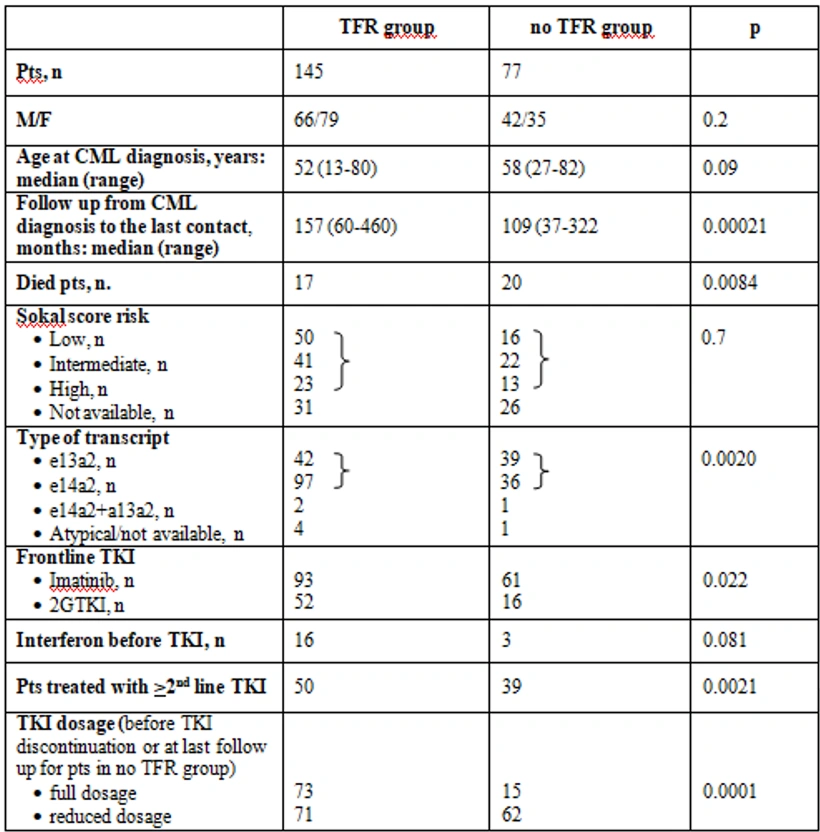
The total number of CP-CML patients treated with TKIs was 332. Of them 19 have received Interferon before. Sixty-two (19 %) pts died, 4 for progression to blast phase and 58 (whose median age at death was 83 years, range 58-95) for causes not related to CML; 6 pts were lost at follow up; 264 pts are presently in follow up (in TKIs treatment or in TFR). Among the 222 pts with a follow up of 5 years or more, focus of our analysis, 145 (65%) reached TFR criteria and discontinued TKIs (TFR group), while the remaining 77 pts (35%) didn’t reach TFR criteria and continued treatment (no-TFR group). The characteristics of the 2 groups are summarized in table 1. In univariate analysis, they showed statistically different features, in detail: pts in TFR group had a longer follow up, better overall survival, a higher percentage of e14a2 transcript type compared to e13a2, a higher percentage of frontline second generation TKIs (2GTKIs). In the no-TFR group more pts needed TKIs beyond 1st line therapy and more pts were treated with reduced TKIs dosage. No patients with follow up > 5 years died for progression to blast phase. Between “TFR group” and “no-TFR group” there were no significant differences of age at the moment of CML diagnosis and of the 3 different Sokal risk score category. At the last contact, 99/145 pts (68%) in TFR group remain in TFR, that is 99/222 (45%) of the pts with a follow up of at least 5 years. Fourteen out of 99 pts reached a persistent TFR after a 2nd TKIs discontinuation attempt. In the TFR group, median follow up from CML diagnosis to the last contact was 157 months (64-460), median follow up from the start of TKIs treatment to TKIs discontinuation 100 months (60-266), median follow up from TKIs discontinuation 45 months (4-138). The impact of different variables on the TFR maintenance was analyzed: the duration of TKIs therapy > 10 years resulted a statistically significant favorable factor (p 0.05) while only a trend in favor of e14a2 transcript type and full dosage TKIs therapy was observed. None of the pts in TFR group experienced disease progression to blast phase. Pts failing TFR attempt resumed therapy with rapid recovery of an optimal molecular response.
According to our experience, more than 40% of CP-CML pts starting TKIs can reach and maintain a durable TFR: therefore, these pts can be considered potentially cured. Frontline 2GTKIs, full dosage TKIs treatment and the presence of the e14a2 transcript type are associated to a higher probability of achieving this goal.
ASCIMINIB VERSUS SECOND-GENERATION TKIS IN CHRONIC-PHASE CML AFTER ≥2 PRIOR TKIS: A PROPENSITY SCORE-MATCHED ANALYSIS
Asciminib (ASC) is approved for chronic-phase chronic myeloid leukemia (CML-CP) after failure of ≥2 tyrosine kinase inhibitors (TKIs), demonstrating superior outcomes versus bosutinib in ASCEMBL (Rea et al., Blood 2021). However, its efficacy compared with second-generation TKIs (2G-TKIs), including nilotinib and dasatinib, remains unclear due to lack of direct comparisons.
This retrospective study carried out by Noora Obaidallah and her group compared outcomes between ASC and 2G-TKIs using propensity score matching (PSM) to adjust for baseline differences.
We retrospectively analyzed CML-CP patients who received third-line or later TKI therapy at Princess Margaret Cancer Centre between September 2010 and October 2024. Patients receiving ASC were compared with those treated with 2G-TKIs (dasatinib, nilotinib, or bosutinib). A total of 106 patients were identified (53 per group). Primary endpoints were 2-year failure-free survival (FFS) and event-free survival (EFS). FFS was calculated from treatment initiation to the earliest occurrence of treatment failure, defined according to ELN 2020 criteria as confirmed loss of MMR in two consecutive assessments, progression to accelerated phase (AP) or blast crisis (BC), or death from any cause. Patients without an event were censored at the date of last assessment. EFS was defined similarly to FFS but additionally included treatment discontinuation due to adverse events (AEs). Secondary endpoints included 1-year molecular responses (MR2 <1% IS; MMR <0.1% IS; MR4 <0.01% IS) and 2-year overall survival (OS). PSM was performed using logistic regression based on age (>60 vs. ≤60), BCR::ABL1 (>10% vs. ≤10%), line of therapy (3rd vs. ≥4th), and prior TKI failure reason (resistance vs. intolerance). After matching, 37 patients per group remained.
Before PSM, ASC patients were older (median 64 vs. 53 years, p<0.001), more often ≥60 years (57% vs. 32%, p=0.011), and had more prior TKIs (≥4: 34% vs. 15%, p=0.024). Higher baseline BCR::ABL1 (>10%) was more frequent (38% vs. 21%, p=0.055). Resistance was more common with ASC (51% vs. 34%), while intolerance was more frequent with 2G-TKIs (66% vs. 49%, p=0.070). Median follow-up was shorter with ASC (704 vs. 1720 days, p<0.01).
At 2 years, FFS was 82% (95% CI, 66.8–90.8) vs. 74% (95% CI, 60.2–84.4) (HR 0.63, 95% CI 0.27–1.49; p=0.29) and EFS was 84% (95% CI, 69.7–92.4) vs. 74% (95% CI, 60.2–84.4) (HR 0.54, 95% CI 0.22–1.33; p=0.18) for ASC vs. 2G-TKIs. AE-related discontinuation was lower with ASC (5.7% vs. 22.6%, p=0.012). One-year responses were MR2 78% vs. 93% (p=0.19), MMR 63% vs. 71% (p=0.42), and MR4 42% vs. 45% (p=0.66). OS was 92% vs. 98% (p=0.58).
After PSM, baseline characteristics were balanced. At 2 years, FFS was 83% (95% CI, 65.9–91.9) vs. 72% (95% CI, 53.9–83.8) (HR 0.53, 95% CI 0.20–1.41; p=0.20) and EFS was 86% (95% CI, 69.3–93.9) vs. 72% (95% CI, 53.9–83.8) (HR 0.43, 95% CI 0.15–1.23; p=0.12). AE-related discontinuation remained lower with ASC (5.4% vs. 24.3%, p=0.022). Molecular responses and OS were comparable (OS 94% vs. 97%; HR 1.19, 95% CI 0.20–7.10; p=0.85).
In this real-world cohort, ASC showed numerically improved FFS and EFS over 2G-TKI, though not statistically significant, while molecular response rates and OS were comparable. ASC was consistently associated with significantly fewer AE-related discontinuations both before and after PSM, supporting a favorable tolerability profile. These findings suggest that ASC is an effective and well-tolerated later-line option in CML-CP.
RISK OF PERMANENT FRONTLINE DISCONTINUATION DURING THE FIRST 36 MONTHS OF THERAPY WITH TYROSINE KINASE INHIBITORS IN CHRONIC MYELOID LEUKEMIA: A “CAMPUS CML” STUDY WITH A NEW “AD HOC” SCORE PROPOSAL
The first 3 years of frontline therapy with Tyrosine Kynase Inhibitors (TKI) are crucial to achieving optimal response in patients (pts) with Chronic Myeloid Leukemia (CML): in this early phase, however, different toxicities or suboptimal response/resistance may occur, leading to permanent frontline TKI discontinuation and need for a 2nd-line switch. The aim of the study -led by Roberto Latagliata and his group- is to evaluate in a large real-life cohort of CML pts all types of events leading to a permanent frontline TKI discontinuation during the first 3 years and to propose a new “ad hoc” score. 1713 CML pts diagnosed from 1/2012 and 12/2019 at 35 Hematology Centres were retrospectively analysed. To derive a clinical score, a stratified data partition was performed, splitting pts into a training cohort (1/3, n = 573) and an independent validation cohort (2/3, n = 1140) using stratified sampling based on the joint distribution of treatment discontinuation status at 36 months. Variables showing a significant association by univariate analysis were considered for multivariable modeling. To enhance model stability and explore data augmentation strategies, a synthetic expansion of the training dataset was performed. Several algorithms were applied to generate a 3-fold synthetic expansion of the training dataset (n = 1719): the synthetic dataset with the lowest propensity score Mean Squared Error (pMSE) and a standardized pMSE value closest to 1 was selected for further analysis. A data-driven grid search approach was applied to determine optimal cut-off values for these variables. The resulting risk score was finally tested in the independent validation cohort to evaluate its discriminative performance.
Frontline TKI was IM in 976 (56.9%) and 2G-TKIs in 737 (43.1%) pts. Total number of pts who had discontinued frontline TKI at the 36th month of observation was 536/1713 (31.3%), being higher with IM (366/976, 37.5%) than with 2G-TKIs (170/737, 23.0%) (p<0.001). Among the 536 pts who discontinued frontline TKI, the main causes were hematologic toxicity in 34 (6.4%), extra-hematologic toxicity in 171 (31.9%), primary resistance in 228 (42.5%), secondary resistance in 27 (5.0%), blastic phase evolution in 23 (4.3%), unrelated deaths in 42 (7.8%) and other causes in 11 (2.1%). At multivariate analysis, age (OR 1.01, 95% CI 1.00–1.02; p = 0.002), hemoglobin (OR 0.87, 95% CI 0.82–0.92; p < 0.001) and spleen size (OR 1.07, 95% CI 1.03–1.11; p < 0.001) retained an independent predictive role for TKI discontinuation. The optimal combined cut-offs identified by the grid-search procedure were age ≥ 63.5 years, hemoglobin ≤ 10.2 g/dL, and the presence of any degree of splenomegaly. An aggregated score based on these 3 cut-offs (low-risk 0-1 variables, high risk 2-3 variables) enabled a strong risk stratification of pts, effectively predicting the likelihood of treatment discontinuation. This discriminative ability was consistently observed in both the training and validation cohorts and was maintained across subgroup analyses stratified by frontline imatinib versus 2G-TKI treatment (Figure).
By integrating conventional statistical methods with advanced machine learning approaches, we developed a clinically applicable risk score based on simple baseline parameters. This score enables effective stratification of the risk of TKI early discontinuation, facilitating practical bedside implementation and supporting a more personalized therapeutic strategy.
