RADIOTHERAPY AS BRIDGING, SALVAGE OR CONSOLIDATION STRATEGY IN CAR-T–TREATED LYMPHOMA PATIENTS: INSIGHTS FROM THE FRENCH DESCAR-T REGISTRY
Vincent Camus et al
Centre Henri Becquerel, Department of Hematology and INSERM U1245 "Cancer & Brain Genomics", Rouen, France
Background
- Radiotherapy (RT) is frequently used in lymphoma patients (pts) eligible for CAR-T cells, either as holding/bridging therapy before infusion or as salvage/consolidation after infusion. However, large real-world data evaluating its impact on outcomes are limited.
- The authors analyzed the role of RT in CAR-T–treated pts from the French national DESCAR-T registry.
Methods
- This study included B-cell lymphoma pts from DESCAR-T (NCT04328298) who received RT either as (i) holding/bridging therapy before first CAR-T infusion (Population 1, pop1) or (ii) salvage (SRT) or consolidation RT (CRT, RT delivered after CAR-T without evidence of progression) within 6 months (mo) after infusion (Population 2, pop2).
- Survival endpoints (PFS and OS) were assessed from first CAR-T infusion. Patients were censored at their second infusion. Objective response was analyzed through ORR, CRR and DOR. Safety was evaluated through CAR-T specific toxicity, persisting cytopenias (lasting ≥30 days) and death. Irradiated sites were not collected.
Results
- In pop1 (n=303), 183 pts received RT alone (RTa) and 120 RT combined with systemic therapy (RTc). Median age was 64 years (range 19–81). A majority of LBCL (82%) was observed with small proportions of PMBL (6%), FL (5%), and MCL (4%). Advanced stage was reported in 67.8% of pts (RTa 63% vs RTc 76%), and elevated LDH in 58% (RTa 55% vs RTc 64%).
- Median prior treatment lines before CAR-T was 2 (range 1-8). Best ORR after CAR-T was 86.6% (95% CI 82.2–90.2), including CRR 72.5% (67–77.5). Responses were higher with bridging RTa vs RTc: ORR 90.7% (85.5–94.5) vs 80.2% (71.7–87); CRR 79.1% (72.5–84.8) vs 62.1% (52.6–70.9). Median follow-up since CAR-T infusion was 24.6 mo. Among responders (n=258), 38.8% had a subsequent event (progression/death).
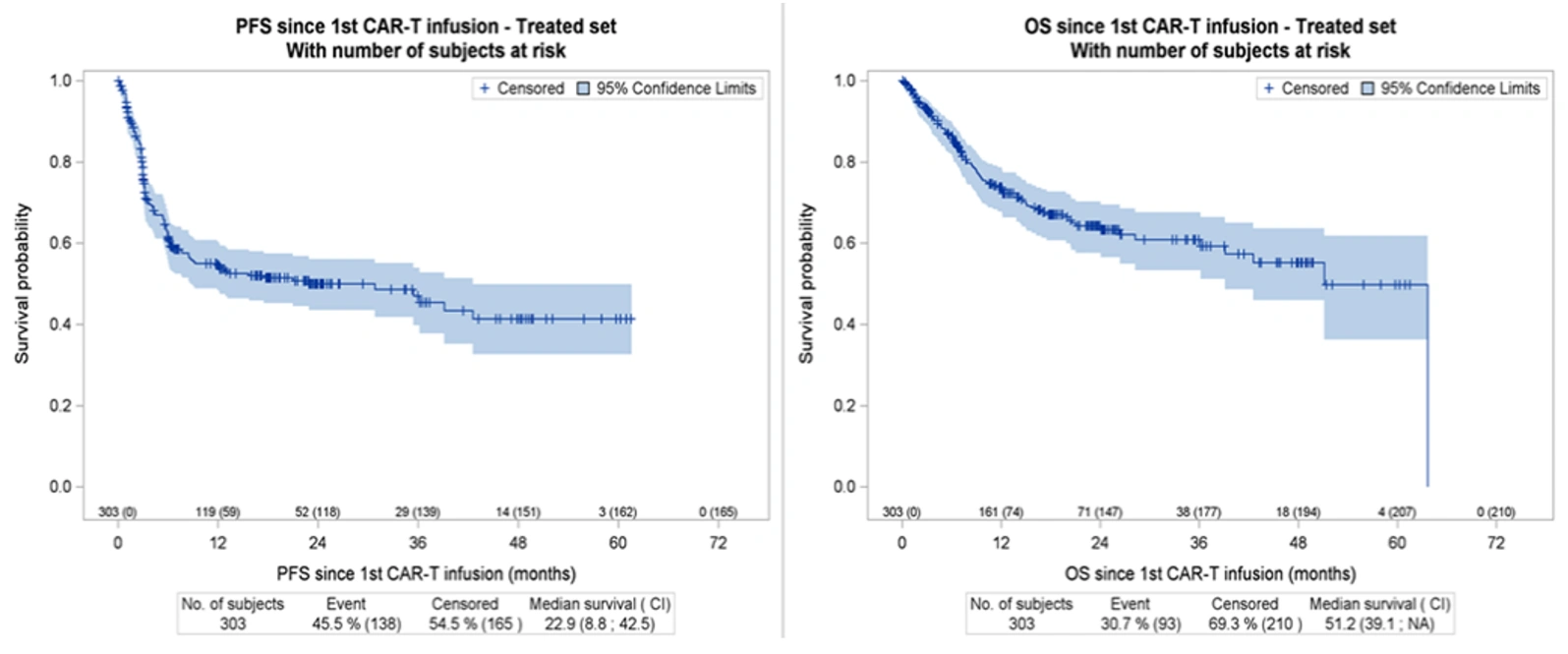
- Median DOR was 41.8 mo (29.9–NA), with 12- and 24-month DOR rates of 61.4% (54.7–67.4) and 57.7% (50.6–64.1), respectively. In pop1, 93 deaths (31%) occurred after first infusion; 75% were due to progression. Median PFS and OS were 22.9 mo (8.8–42.5) and 51.2 mo (CI 39.1–NA), respectively (Figure 1).
- CAR-T toxicities were consistent with expected profiles: CRS occurred in 82.5% vs 83.2% (grade ≥3: 4.4% vs 1.7%) and ICANS in 41% vs 45.4% (grade ≥3: 11.4% vs 12.6%) for RTa vs RTc. Prolonged cytopenias persisted at month 3 (16.5% vs 13.3%) and month 6 (7.1% vs 13%).
- In pop2 (n=113), 91 pts received SRT and 22 CRT. Median age was 58 years (range 18–78). A majority of LBCL was observed (86%), with small proportions of PMBL (9%), FL (4%), and MCL (1%). Advanced stage and elevated LDH were reported in 79.6% and 73.9% of pts. Median prior treatment lines before CAR-T was 2 (range 1–6). Median follow-up since CAR-T infusion was 26.8 mo. ORR after RT was not collected.
- Overall, 49 deaths (43.4%) occurred; 88% were due to progression. Median PFS was 2.1 mo (1.9–2.8) with SRT vs 14.3 mo (4.4–NA) with CRT. Median OS was 15 mo (11.2–37.2) with SRT and was not reached with CRT.
Conclusion
- In this large national real-world cohort, RT delivered as holding/bridging before CAR-T was associated with high response rates and durable remissions, including in pts with advanced-stage disease. Post-CAR-T RT demonstrated limited efficacy in the salvage setting but encouraging disease control when used as consolidation.
- No excess CAR-T–related toxicity was observed in pts exposed to RT. These findings support the strategic integration of RT in peri–CAR-T management and warrant prospective evaluation.