

IPTACOPAN DEMONSTRATES SUSTAINED EFFICACY AND SAFETY IN PAROXYSMAL NOCTURNAL HEMOGLOBINURIA: UP TO 4 YEARS OF FOLLOW-UP IN PATIENTS FROM APPLY, APPOINT AND ROLL-OVER EXTENSION PROGRAM
Iptacopan demonstrated sustained hematologic control and a favorable safety profile in patients with paroxysmal nocturnal hemoglobinuria (PNH) in phase 3 studies APPLY-PNH (NCT04558918) and APPOINT-PNH (NCT04820530), with efficacy and safety maintained from 24-48 weeks in the parent studies to 2 years in the roll-over extension program (PNH-REP; NCT04747613).
The aim of the study- led by Régis Peffault de Latour et al. (Université Paris Cité, Paris)- is to assess the long-term safety and efficacy of iptacopan monotherapy in patients with PNH who initiated treatment with iptacopan in APPLY-PNH and APPOINT-PNH with up to 4 years’ follow-up.
All patients received iptacopan monotherapy 200 mg twice daily across parent studies and PNH-REP; the first dose in parent study was considered as baseline (BL). Efficacy assessments included hemoglobin (Hb), lactate dehydrogenase (LDH), absolute reticulocyte count (ARC), transfusion avoidance, breakthrough hemolysis (BTH) rates and prevention of major adverse vascular events (MAVEs). Safety assessments included treatment-emergent adverse events and serious adverse events (SAEs).
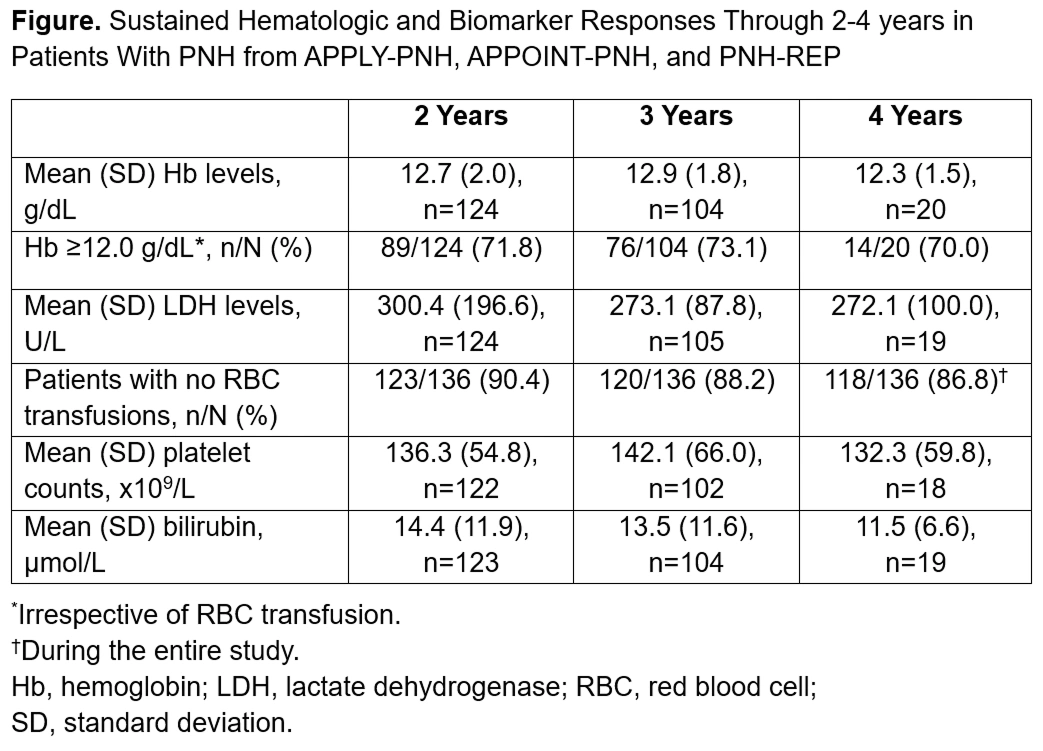
At data cut-off, study participation was completed or ongoing in 122/136 patients (89.7%). Hematologic efficacy was sustained, with results comparable across 2, 3 and 4 years (Figure). At 3 and 4 years, mean (SD) Hb was 12.9 g/dL (1.8) and 12.3 g/dL (1.5), respectively, with Hb ≥12.0 g/dL achieved in 76/104 (73.1%) and 14/20 patients (70.0%), irrespective of blood transfusion. Control of intravascular hemolysis was maintained, with LDH levels <1.5×ULN in 95/105 patients (90.5%) at 3 years and 18/19 (94.7%) at 4 years. Markers of extravascular hemolysis showed improvement; mean (SD) ARC decreased by −100.9 (69.1) and −114.7×10⁹/L (55.8) at 3 and 4 years, with ARC normalization observed in 96/104 (92.3%) and 18/19 patients (94.7%), respectively. Mean (SD) changes from BL for bilirubin at 3 and 4 years were −18.3 µmol/L (23.4) and −15.1 µmol/L (9.8), respectively. Mean (SD) changes from BL in platelet count were −10.3×10⁹/L (52.8) and −11.2×10⁹/L (46.1), respectively. Overall, 118/136 patients (86.8%) remained transfusion-free throughout the treatment period. Mean (SD) FACIT-F score improvements from BL were 9.3 (10.8) and 8.2 (9.1) at 3 and 4 years, respectively.
There were 37 BTH events in 23 patients (8.3 events/100 patient years [py]), including 6 serious events (1.3 events/100 py); all events resolved, and no BTH led to treatment discontinuation. Six MAVEs occurred in 5 pts (1.3 events/100 py), including 3 severe events in 2 patients; 1 event of intestinal infarction resulted in death.
SAEs occurred in 50/136 patients (36.8%), including serious infections and infestations in 24/136 patients (17.6%; 8.7/100 py). Five deaths (3.7%) occurred due to cardiopulmonary failure following sepsis, gastrointestinal hemorrhage, metastatic colorectal cancer, pneumonia, and infection with ascites followed by intestinal infarction. No death was related to iptacopan treatment. Nine pregnancies were reported; of these, 4 resulted in elective abortions, 2 in spontaneous abortions, 1 in ectopic pregnancy and 2 in healthy live births.
With up to 4 years of follow-up, iptacopan monotherapy demonstrated sustained efficacy, with hemolysis control, high transfusion avoidance, and improved fatigue in patients with PNH. Long-term treatment was well tolerated, with no new safety findings.
CONSISTENT AND SUSTAINED EFFICACY AND SAFETY OF IPTACOPAN IN PAROXYSMAL NOCTURNAL HEMOGLOBINURIA REGARDLESS OF PRIOR HISTORY OF MAJOR ADVERSE VASCULAR EVENTS IN APPLY, APPOINT AND EXTENSION PROGRAM
In the phase 3 APPLY-PNH (NCT04558918) and APPOINT-PNH (NCT04820530) studies and the roll-over extension program (PNH-REP; NCT04747613) iptacopan showed sustained hematologic control and a favorable safety profile in patients with paroxysmal nocturnal hemoglobinuria (PNH). Patients with a prior history of major adverse vascular events (MAVEs) are a clinically important high-risk subgroup.
The aim of the study-carried out by Bing Han et al. (Peking Union Medical College Hospital, Beijing)- is to report the safety and efficacy of iptacopan in patients from APPLY-PNH, APPOINT-PNH and the PNH-REP, according to prior history of MAVEs.
All patients received iptacopan monotherapy 200 mg twice daily during the parent studies and the PNH-REP. The first dose was considered baseline. Efficacy assessments included levels of hemoglobin and lactate dehydrogenase (LDH), absolute reticulocyte count, transfusion avoidance, FACIT-fatigue score, breakthrough hemolysis (BTH) rates and prevention of MAVEs. Safety assessments included incidence of treatment-emergent adverse events (TEAEs) and serious adverse events (SAEs).
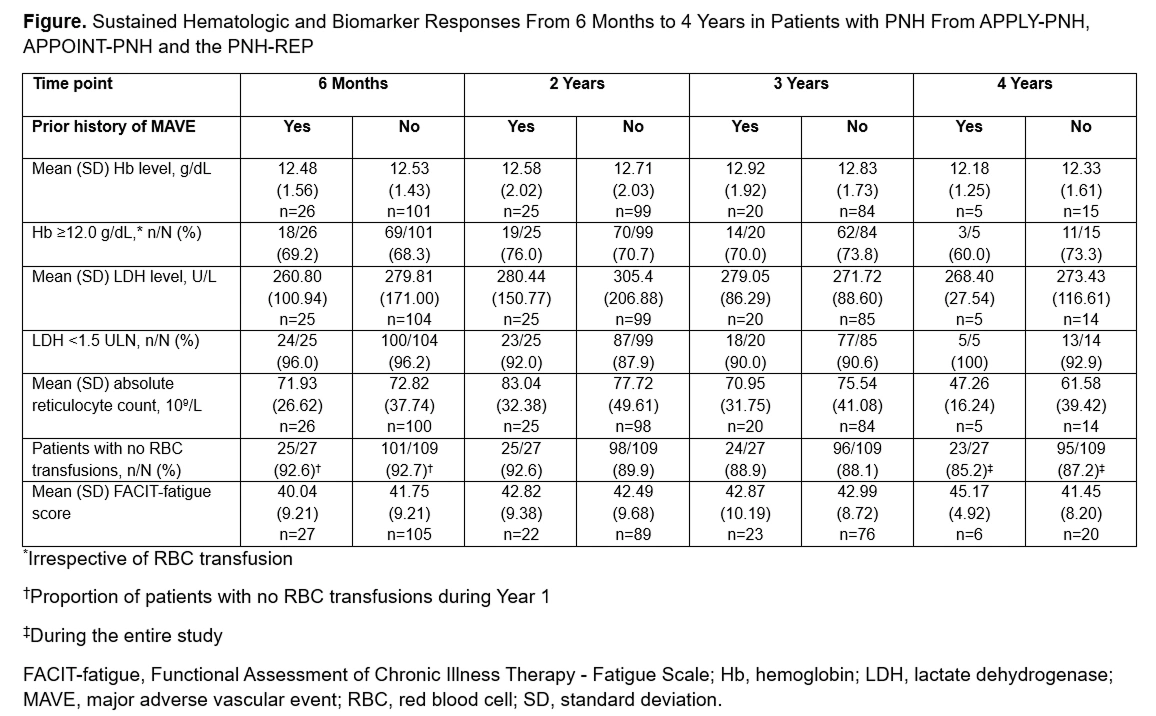
The analysis population comprised 136 patients; 27 (19.9%) had a history of MAVE (HoM) and 109 (80.1%) had no history of MAVE (NHoM). Baseline demographics and clinical characteristics were similar between the subgroups. At data cut-off, study participation was completed or ongoing in 23/27 (85.1%) of HoM patients and 99/109 (90.8%) of NHoM patients. Hemolytic control was consistently sustained with up to 4 years’ follow up, regardless of whether patients had a prior history of MAVE (Figure). BTH occurred in 2/27 HoM patients (2.3 events/100 patient-years [py]) and 21/109 NHoM patients (9.7 events/100 py). A total of 6 MAVEs occurred in 5 patients, originating from the APPLY-PNH study (1.3 events/100 py). MAVEs occurred in 2/27 (7.4%) HoM patients. Of these, 1 patient with a history of portal thrombosis had another portal thrombosis (this patient had chosen to discontinue anticoagulation 2 weeks prior to the event) and an intestinal infarction (resulted in death); the other, with history of thrombophlebitis/deep vein thrombosis, had another event of thrombophlebitis/deep vein thrombosis, while not receiving anticoagulation. MAVEs occurred in 3/109 (2.8%) NHoM patients; all had ≥1 cardiovascular or cardiometabolic risk factor. Each had an event of transient ischemic attack. No patient in whom MAVEs occurred had BTH at any time. Overall, the most frequent TEAEs were COVID-19, nasopharyngitis and headache, which occurred in 44.4% and 50.5%, 18.5% and 26.6%, and 3.7% and 28.4% of patients with and without HoM, respectively. One patient in each subgroup had adverse events leading to treatment discontinuation. SAEs occurred in a higher proportion of HoM patients (14 [51.9%]; 33.8 events/100 py) than NHoM patients (36 [33.0%]; 20.3 events/100 py). SAEs related to infections occurred in 6 (22.2%; 13.5 events/100 py) and 18 (16.5%; 7.5 events/100 py) of HoM and NHoM patients, respectively.
Hematologic control was consistent and sustained with iptacopan treatment in patients with PNH with or without prior history of MAVE. On-study MAVEs were rare and occurred in patients with pre-study MAVE history or cardiovascular or cardiometabolic risk factors. Iptacopan was well tolerated in both subgroups. These findings suggest durable hematologic control with iptacopan in patients with PNH, accompanied by low incidence of MAVEs, including in patients with prior events.
REAL-WORLD OUTCOMES OF IPTACOPAN IN PAROXYSMAL NOCTURNAL HEMOGLOBINURIA (PNH) PATIENTS: INSIGHTS FROM THE FRENCH EARLY ACCESS PROGRAM.
Iptacopan is the 1st oral monotherapy targeting Factor B to inhibit the proximal alternative complement pathway, effectively controlling both intra and extravascular hemolysis in paroxysmal nocturnal hemoglobinuria (PNH). In the APPLY-PNH randomized trial, iptacopan was superior to antiC5 therapies (C5i) in improving hemoglobin (Hb) and reducing red blood cell transfusion (RBCT) in patients with persistent anemia. Since May 2, 2024, an Early Access Program (EAP) have enabled iptacopan access in France for adults with PNH with anemia despite C5i. The aim of the study- carried out by Alexander Röth et al. (West German Cancer Center, University Hospital Essen)- is toreport the real-world effectiveness and safety of iptacopan in France.
Eligibility criteria wereadult patients with PNH clone size ≥10% and Hb <10 g/dL despite 6 months of C5i. Patients intolerant to 2nd line proximal inhibitor (C3i) were eligible if previously received ≥6 months of C5i with Hb <10 g/dL at switch. Treatment initiation required vaccination and validation by the French reference center multidisciplinary team. Clinical and biological data are collected at treatment request, initiation and subsequently at day 15 (D15), month 2 (M2), and every 2 months during year 1, then every 4 months thereafter.
Overall, 51 initiated iptacopan and were included by 22 physicians (mean age 47.9 ± 17.9 years; 64.7% women). Prior thrombotic events were reported for 15 patients (29.4%). Among these patients, 4 had previously started iptacopan through compassionate access and 7 initiated treatment following intolerance to a 2nd line C3i. These 11 patients had Hb >10 g/dL at treatment request. Among the other 40 patients previously treated by C5i, RBCT in the 12 months preceding treatment was required for 22 patients (55.5%) (mean number transfusions per patient: 10.6 ± 10.1). Mean exposure to iptacopan was 7.6 ± 4.5 months (min: 0; max: 17.4 months).
In the Hb ≤10 g/dL subgroup (N=40), mean (±SD) Hb increased significantly and rapidly from baseline (8.65 ± 0.97 g/dL) by 3.01 ± 1.79 g/dL (11.66 ± 1.53 g/dL) at D15, followed by progressive increases at subsequent visits:+4.44 ± 1.40 g/dL at M6 (13.07 ± 1.11 g/dL), and +4.60 ± 1.92 at M12 (13.26 ± 1.44 g/dL). Transfusion independence increased from 50% at baseline to 95% at D15 and 100% at M12. In the Hb >10 g/dL subgroup (N=11), mean Hb (baseline: 12.30 ± 0.95 g/dL) increased by 0.56 ± 0.81 at D15, and by 0.99 ± 1.24 at M2 and then remained stable, exceeding 13g/dL during follow-up, demonstrating durable long‑term control in this previously treated population. All patients were transfusion independent from D15.
No death, thromboembolic events or breakthrough hemolysis (BTH) were reported. Overall, 6 patients experienced a total of 16 serious adverse drug reactions (ADR) and 9 non-serious. Two serious infections (pneumonia and cystitis) were reported. Of the 4 patients experiencing serious ADRs two achieved full recovery, one was reported as condition improving, and the remaining case had no documented outcome. None of the ADR resulted in modification or discontinuation of iptacopan.
The EAP confirms the real-world effectiveness and safety of iptacopan demonstrated in the clinical trials. Patients with Hb <10 g/dL showed rapid and sustained Hb improvement with markedly reduced transfusion needs from D15, while patients with prior iptacopan or C3i treatment with Hb >10 g/dL remained stable without BTH reported. Overall, no new safety signals were identified.
LONG-TERM HEMATOLOGIC CONTROL AND SAFETY IN PATIENTS WITH PAROXYSMAL NOCTURNAL HEMOGLOBINURIA TREATED WITH IPTACOPAN: 6-YEAR FOLLOW-UP FROM PHASE 2 STUDIES AND ROLL-OVER EXTENSION PROGRAM
Iptacopan has shown sustained hematologic control and a favorable safety profile in patients with paroxysmal nocturnal hemoglobinuria (PNH).
The aim of the study- led by Antonio M. Risitano et al. (University of Naples, Federico II)- is to report long-term safety and efficacy outcomes with up to 6 years of follow-up from patients with PNH who received iptacopan 200 mg twice daily (BID) in two phase 2 studies (NCT03439839 and NCT03896152) and an ongoing roll-over extension program (PNH-REP; NCT04747613).
Long-term data were reported for patients from the phase 2 studies and PNH-REP. Baseline was defined as the first day of receiving iptacopan 200 mg BID. Efficacy outcomes included mean hemoglobin (Hb) levels and Hb ≥12.0 g/dL, mean lactate dehydrogenase (LDH) levels and LDH <1.5×upper limit of normal (ULN), mean absolute reticulocyte count (ARC) and ARC normalization, transfusion independence, hematologic parameters, Functional Assessment of Chronic Illness Therapy (FACIT)-Fatigue, breakthrough hemolysis (BTH) rates, and prevention of major adverse vascular events (MAVEs). Safety assessments included frequency and number of events per 100 patient years (py) of treatment-emergent adverse events (TEAEs) and serious TEAEs.
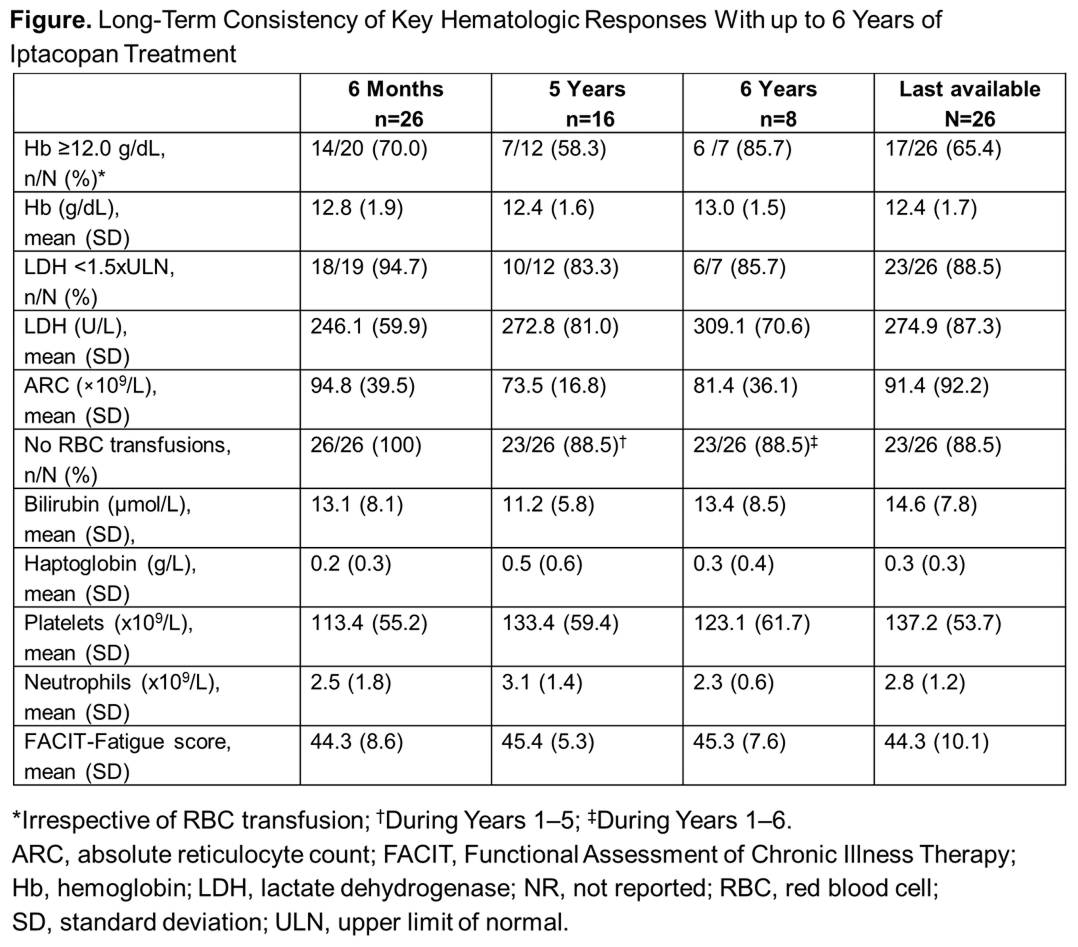
Of the 26 patients treated with iptacopan 200 mg BID in the phase 2 studies, 22 entered the PNH‑REP; at data cut-off, 21/26 (80.8%) patients were ongoing, 1 (3.8%) had completed the study, and 4 (15.4%) had discontinued. Sixteen of 26 (61.5%) patients had ≥5 years and 8/26 (30.8%) had ≥6 years of exposure; median duration of exposure was 66.1 months. Hematologic response was sustained from 6 months to 6 years (Figure). At 5 and 6 years, Hb ≥12.0 g/dL irrespective of red blood cell (RBC) transfusion was achieved by 7/12 (58.3%) and 6/7 patients (85.7%) with available data, respectively, and LDH <1.5×ULN was achieved by 10/12 (83.3) and 6/7 patients (85.7%), respectively. ARC normalization at 5 and 6 years was achieved by 12/12 (100%) and 6/7 patients (85.7%), respectively, with mean (SD) being 73.5 (16.8) and 81.4×10⁹/L (36.1). Most patients (23/26 [88.5%] at 5 and 6 years) remained RBC transfusion-free. Bilirubin and haptoglobin levels, platelet and neutrophil counts, and FACIT-Fatigue scores observed at 6 months were sustained to 6 years. Overall, 6 BTH events (none serious) occurred in 5/26 patients (19.2%; 4.7/100 py): 2 mild, 3 moderate, and 1 severe event (deemed study drug-related by investigators). A MAVE (unstable angina) was reported in 1/26 patients (3.8%; 0.8/100 py) who had pre-existing hypertension, left ventricular hypertrophy, and nephropathy.
In total, 23/26 patients (88.5%) reported ≥1 TEAE, most frequently COVID-19 and pyrexia (30.8% each). Serious TEAEs occurred in 11/26 patients (42.3%; 13.2/100 py), with serious infections in 3/26 patients (11.5%; 3.9/100 py). Three of 26 (11.5%) patients died during phase 2 studies; no events leading to deaths were deemed study drug-related.
Over a 6-year follow-up, iptacopan treatment was associated with sustained hematologic control, including maintenance of Hb levels and transfusion independence. In most of the patients, LDH <1.5×ULN and ARC normalization were achieved at 6 months through to 6 years, showing control of intravascular hemolysis and absence of treatment-emergent extravascular hemolysis. Low rates of BTH and MAVEs were observed. A consistent safety profile was maintained, with no new safety findings compared with previous reports. These findings further characterize the long-term effects of iptacopan treatment in patients with PNH.
LONG-TERM SAFETY WITH IPTACOPAN TREATMENT IN PATIENTS WITH PAROXYSMAL NOCTURNAL HEMOGLOBINURIA (PNH): POOLED ANALYSIS OF DATA FROM PHASE 2 AND 3 STUDIES AND THE ROLL-OVER EXTENSION PROGRAM
Iptacopan demonstrated sustained hematologic control and a favorable safety profile in patients with paroxysmal nocturnal hemoglobinuria (PNH) in phase 2 and 3 studies and the roll-over extension program (PNH-REP); long-term safety data are limited. The aim of the study is to assess long-term safety of iptacopan in patients with PNH using pooled data from phase 2 and 3 studies and the PNH-REP.
Safety data were pooled from 3 phase 3 studies (APPOINT-PNH [NCT04820530]; APPLY-PNH [NCT04558918] and APPULSE-PNH [NCT05630001]), 2 phase 2 studies (X2201 [NCT03439839] and X2204 [NCT03896152]) and the PNH-REP (NCT04747613). Baseline was defined as day 1 of receiving iptacopan 200 mg twice daily in the parent study. Safety assessments included incidence and exposure-adjusted occurrence rates (OccR, expressed as number of events/100 patient-years [py]) of breakthrough hemolysis (BTH), major adverse vascular events (MAVEs), treatment-emergent adverse events (TEAEs) and serious TEAEs. Total cholesterol was calculated in the whole population; high- (HDL) and low-density lipoprotein (LDL) cholesterol endpoints were calculated in the pooled phase 3 populations only.
The analysis population comprised 223 patients. Total iptacopan exposure was 676.1 py; 126 (56.5%) patients were exposed to iptacopan for ≥3 years and 34 (15.2%) for ≥4 years. At data cut-off, 95 (42.6%) patients had completed study, 106 (47.5%) were on study and 22 (9.9%) had discontinued treatment, including 3 (1.3%) due to adverse events (AEs), 2 (0.9%) due to pregnancy and 8 (3.6%) due to death. BTH occurred in 29 (13.0%) patients (OccR 6.7 events/100 py) and serious BTH events in 6 (2.7%; OccR 0.9 events/100 py). Eight MAVEs were reported in 7 (3.1%) patients (OccR 1.2 events/100 py). These included transient ischemic attack (3 patients); lacunar infarction, unstable angina, thrombophlebitis/deep vein thrombosis (1 patient each); intestinal infarction and portal vein thrombosis (in the same patient). Overall, 210 (94.2%) patients experienced ≥1 TEAE (OccR 329.4 events/100 py). Most frequently reported TEAEs were COVID-19 in 79 (35.4%) patients (OccR 13.8 events/100 py), nasopharyngitis in 50 (22.4%; OccR 11.4 events/100 py) and headache in 47 (21.1%; OccR 11.5 events/100 py). Sixty-seven (30.0%) patients experienced ≥1 serious TEAE (OccR 19.4 events/100 py), of which infections were the most frequent, in 29 (13.0%) patients (OccR 7.0 events/100 py). To evaluate potential lipid alterations, cholesterol levels were assessed. Mean (SD) total cholesterol was 4.9 (1.2) mmol/L at year 3 (n=129) and 5.0 (1.0) mmol/L at year 4 (n=32), with respective mean (SD) elevations of 0.9 (0.9) and 1.1 (0.7) mmol/L from baseline. HDL cholesterol remained stable with mean (SD) change from baseline of 0.0 (0.3) and 0.1 (0.3) mmol/L at years 3 and 4, respectively; LDL cholesterol showed a mean (SD) increase from baseline of 0.8 (0.8) mmol/L at both timepoints. Of 9 reported pregnancies, 4 resulted in elective abortions, 2 in spontaneous abortions, 1 in ectopic pregnancy and 2 in healthy live births.
The safety profile of iptacopan in this pooled analysis of long-term safety data is consistent with that previously reported, with no new safety findings. MAVEs and serious BTH events were infrequent; there were minimal changes in LDL cholesterol levels. Rates of treatment discontinuation for AEs were low. These findings demonstrate that iptacopan is well tolerated in the long-term treatment of PNH.
CLINICAL BURDEN OF PNH PATIENTS WITH HEMOGLOBIN BETWEEN ≥10 AND <12 G/DL: RESULTS FROM A MULTINATIONAL REAL-WORLD STUDY
Paroxysmal nocturnal hemoglobinuria (PNH) is an ultra-rare clonal hematopoietic stem cell disorder which renders red blood cells sensitive to complement-mediated destruction. PNH is characterized by hemolytic anemia, bone marrow failure, and thrombosis. Common manifestations include fatigue, dyspnea, and chest/abdominal pain. Disease modifying treatments include terminal complement inhibitor therapies (Ci) which target complement 5 (C5i) and proximal Cis which target complement 3 (C3i), factor B or D. Improvements in hemoglobin (Hb) above 10 g/dL are viewed as beneficial, yet patients with Hb levels between ≥10 and <12 g/dl still face meaningful burden on their daily living. The aim of this study- carried out by Jörg Schubert et al. (Klinik für Innere Medizin II - Elblandklinikum Riesa)- is to understand the burdens of PNH in patients with Hb levels between ≥10 and <12 g/dl.
Data were drawn from the Adelphi PNH II Disease Specific Programme™, a real-world cross–sectional survey of physicians and their PNH patients, conducted across Canada, France, Germany, Italy, Japan, Spain and United Kingdom from November 2023–January 2025. Physicians provided data on demographics, clinical symptoms, treatment, and PNH-related hospitalizations. Patients voluntarily provided self-reported data on symptoms, Functional Assessment of Chronic Illness Therapy (FACIT)-fatigue and work productivity and activity impairment (WPAI) questionnaires. Data were analyzed descriptively; missing data were not imputed.
Eighty physicians provided data for 234 PNH patients with Hb levels between ≥10 and <12 g/dl.Patients had a median (interquartile range; IQR) age of 48.0 (37.0–60.0) years, 56.4% were male and 59.9% were in full/part time employment. The median (IQR) time since PNH diagnosis was 2.2 (0.9–4.5) years. Of patients prescribed treatment at the time of survey (n=217), the majority were prescribed Ci (85.7%), with 79.3% and 6.5% prescribed C5 and C3 inhibitor treatment, respectively. Patients (n=181) had been prescribed Ci for a median (IQR) duration of 1.6 (0.7–2.8) years. Among patients diagnosed since at least a year (n=160), 16.9% had at least one PNH-related hospitalization in the 12 months prior to survey, mostly due to infection (44.4%), followed by treatment of PNH-related complications (22.2%), and thrombotic event (14.8%). Additionally, 48.1% were admitted via the emergency room and 92.6% had to stay in hospital overnight for a median (IQR) 5.0 (4.0–7.0) nights.
Sixty-three patients provided self-reported data. The most common patient-reported symptom was tiredness (79.4%), followed by shortness of breath (47.6%), and lack of focus/brain fog (44.4%). Tiredness was also considered the most bothersome symptom by 61.2% of patients. The mean (standard deviation; SD) of FACIT-fatigue score was 38.5 (7.7). Via the WPAI, patients experienced a mean (SD) 25.1 (23.7) percentage overall work impairment (n=24), and mean (SD) 33.7 (25.2) percentage activity impairment (n=62).
Overall, these findings highlight that even PNH patients with mild anemia (Hb levels between ≥10 and <12 g/dL) experience a significant burden on their daily living and working activities. A notable proportion also depend heavily on healthcare resources, reflecting the ongoing challenges associated with managing their condition. Addressing this unmet need is essential to closing gaps in care and ultimately improving patient outcomes.