PROLONGED RESPONSE AFTER TPO-RA DISCONTINUATION IN PRIMARY ITP: LONG TERM FOLLOW-UP OF THE STOPAGO STUDY, A PROSPECTIVE MULTICENTER STUDY
Adrien Cottu,
Service de Médecine Interne, Centre National de Référence des Cytopénies Auto-Immunes de l’Adulte, Henri Mondor Hôpital, Fédération Hospitalo-Universitaire TRUE InnovaTive theRapy for immUne disordErs, Assistance Publique–Hôpitaux de Paris (AP-HP), Créteil, France
Background
- Thrombopoietin receptor agonists (TPO-RAs) are effective treatments for immune thrombocytopenia (ITP). Because of their mechanism of action, TPO-RAs have long been considered as a supportive therapy.
- Recently, several studies have suggested that TPO-RAs may induce prolonged remissions, but their study population included heterogenous patients in whom spontaneous remission may occur regardless of the initial treatment.
- In this setting, the French prospective multicenter STOPAGO study showed a sustained response rate of 50% after TPO-RAs discontinuation among selected patients with chronic ITP who achieved a stable complete response for one year on TPO-RAs.
- Most relapses occurred within four weeks after TPO-RAs discontinuation. No major bleeding events were reported, and TPO-RAs rechallenge resulted in complete response in 90% of these patients. The objective of this work is to update the follow-up of patients enrolled in the STOPAGO study with long-term monitoring.
Methods
- The STOPAGO study (#NCT03119974) was an open prospective, multicenter, interventional study involving 20 centers from the French ITP reference center network.
- Patients were adults with a persisting or chronic ITP who achieved a stable complete response (platelet count > 100 × 109/L for > 2 months) on TPO-RAs (eltrombopag or romiplostim) for more than 3 months. After enrolment, TPO-RAs were gradually tapered and discontinued according to a standardized procedure within 10 weeks.
- Sustained response off treatment (SROT) was defined as platelet count ≥30 × 109/L and no bleeding. Sustained complete response off treatment (SCROT) was defined as a platelet count ≥100 × 109/L and no bleeding without ITP-specific medications.
- Updated longterm follow-up data after the last inclusion were collected by the investigators of the participating centers.
Results
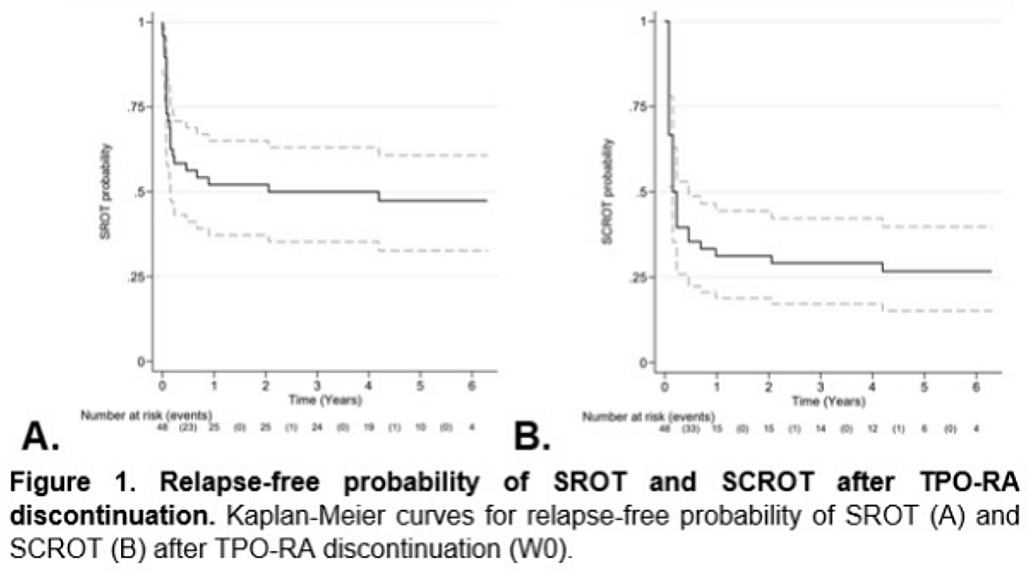
- Between September 2017 and February 2020, 48 patients were enrolled in the STOPAGO study. SROT and SCROT were achieved in 27/48 (56%) and 15/48 (31%) patients at 6 months, and 25/48 (52%) and 14/48 (29%) patients at 12 months, respectively.
- The 25 patients who achieved SROT at 12 months were followed for a median of an additional 5 years (ranging from 3.3 to 6.3 years). Of these, all but 2 patients received eltrombopag for a median of 2.1 [1.1-4.1] years prior discontinuation. SROT and SCROT were achieved in 22/46 (48%) and 17/46% (37%) patients at 4 years, respectively (2 patients lost to follow-up after 3 years). Only 2 (8%) patients relapsed during extended follow-up. No severe bleeding events were reported at the time of relapse.
- The first patient relapsed 5 years after eltrombopag discontinuation. Complete response was achieved within 5 weeks after eltrombopag rechallenge.
- The second patient relapsed 2 years after eltrombopag discontinuation. This relapse was associated with an influenza virus infection. Eltrombopag rechallenge and 3 other treatment lines were ineffective, leading to the recent introduction of fostamatinib.
- One pregnancy (without relapse or neonatal thrombocytopenia), one SARS-CoV-2 infection, one small-cell B lymphoma and one scleroderma without ITP relapse were reported during follow-up.
Conclusions
- Our results show that almost 50% of patients with chronic ITP who achieved a stable complete response with TPO-RAs maintained a sustained response during long-term follow-up after TPO-RAs discontinuation.
- These results confirm that relapses are predominantly early in the first weeks after discontinuation, while late relapses are rare (2 of 25 patients).
- These findings support a discontinuation strategy of TPO-RAs in patients with chronic ITP in stable complete remission.