CLONAL HEMATOPOIESIS IN PATIENTS WITH IMMUNE THROMBOCYTOPENIA: AN INTERNATIONAL MULTICENTER STUDY
Dr. Bruno Fattizzo,
Fondazione IRCCS Ca' Granda Ospedale Maggiore Policlinico and University of Milan, Milan, Italy
Background
- Immune thrombocytopenia (ITP) is caused by an immune-mediated attack to platelets and to bone marrow precursors. Diagnostic borders between ITP and clonal cytopenias, such as low risk myelodysplastic syndromes, may be difficult to establish.
- Somatic mutations by next generation sequencing (NGS) may be found also in individuals without myeloid neoplasms, namely clonal hematopoiesis with indeterminate potential. The prevalence and significance of clonal hematopoiesis in ITP is not known.
- The aim of the study is to evaluate the prevalence and clinical significance of clonal hematopoiesis in adult ITP patients.
Methods
- Adult ITP patients followed at 13 centers in Italy, UK, and USA from 2003 until December 2023 with available NGS data (myeloid panel of >50 genes) were included in the study.
- Mutations with variant allele frequency (VAF) >40% were excluded as likely germline.
- Prevalence and type of mutations detected and their association with clinical and laboratory features of ITP were analyzed.
Results
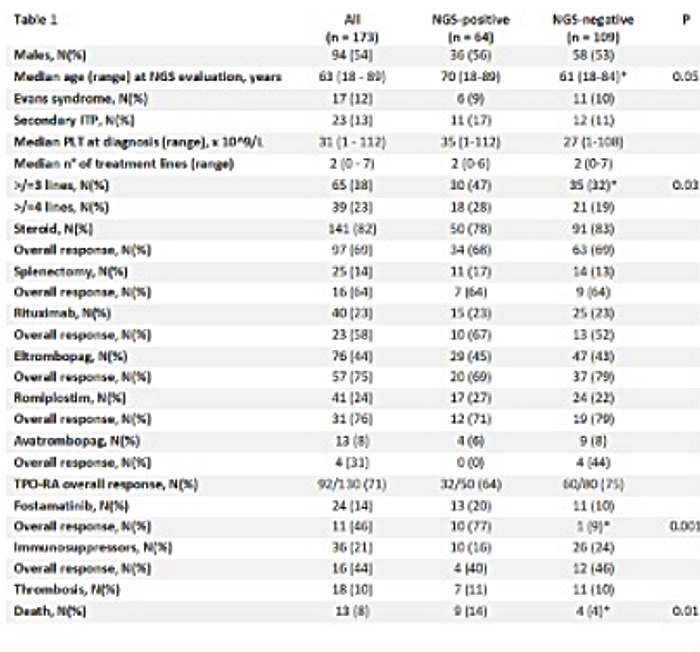
- Overall, 173 ITP patients were included (Table 1), 64 of whom (37%) had at least one mutation, and 35 (20%) two or more. Mutated genes in order of frequency were TET2 (37 mutations), DNMT3A (19), SRSF2 (12), ASXL1 (10), CBL (4), BCOR (4), SETBP1 (3), SF3B1 (3), NF1 (2), TP53 (2); EZH2 (3), MPL (3), EGLN1 (2), IDH2 (2), JAK2 (2), PHF6 (2), CEBPA (1), CBFB::MKL1 (1), RADS21 (1), STAG2 (1) and U2AF1 (1) in one case each.
- Median VAF was 29% (range 2.6 - 39%). NGS-positive patients were significantly older than NGS-negative ones (70 years, range 18-89, versus 61, 18-84, p= 0.05), whilst platelet values at diagnosis, gender, and prevalence of secondary ITP and Evans’ syndrome showed a similar frequency in the two groups.
- With regards to treatment, 82% of subjects received therapy (median of 2 lines, 1-7), mainly steroids (100%), TPO-RA (75%), rituximab (23%), cytotoxic immunosuppressors (21%), and fostamatinib (14%, Table 1); NGS-positive patients were more frequently relapsing/refractory (>3 lines, 47% versus 32% NGS negative, p=0.03); a higher response rate to fostamatinib was also observed although in a small number of patients (10/13 NGS positive, 77% versus 1/11 negative, 9%, p=0.001).
- Overall, 18 patients (10%) experienced a thrombotic complication during disease course, with no association with NGS-mutations.
- No evolution to myeloid neoplasms were observed. During a median follow up of 5 years (similar for NGS positive/negative cases), 13 subjects died, more frequently belonging to NGS-positive group (14% versus 4%, p=0.01). Deaths were not related to ITP.
Conclusions
- These preliminary data show the presence of clonal hematopoiesis in more than 1/3 of ITP patients, being associated with older age and relapse and treatment refractoriness.
- Such frequency, higher than expected in a 60-year-old population (Rossi et al, Blood. 2021), suggests a possible role of disease-related autoimmune attack against marrow precursors and of treatment in clonal selection.